
In the world of industrial instrumentation, a “hermetic seal” refers to a closure that is completely airtight and impervious to gas, moisture, and external contaminants. Unlike standard environmental seals that use gaskets or O-rings, a true hermetic seal is created through the fusion of materials, typically metal-to-metal or glass-to-metal to ensure that the internal electrical or mechanical circuit remains in a perfectly isolated environment. At Whitman Controls, our W117 Ultra Pure series utilized advanced hermetic sealing to meet the most demanding reliability standards in the world.
How Is a True Hermetic Seal Engineered?
A hermetic seal is defined by its ability to prevent the passage of air or gas over a prolonged period. This is achieved through specific high-integrity manufacturing processes.
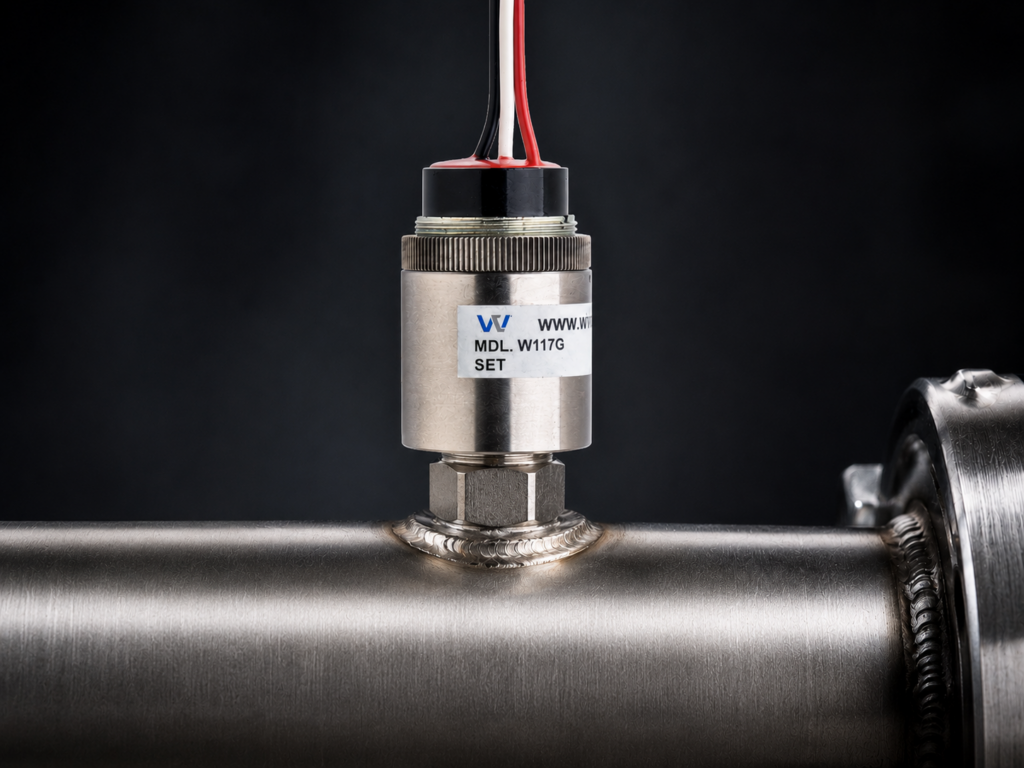
- Electron Beam Welding Components are fused together in a vacuum using a high-energy beam of electrons. This creates a deep, narrow weld with a minimal “heat-affected zone,” ensuring the metallurgical properties of the 316L stainless steel remain intact.
- Welded Diaphragm Construction By eliminating internal elastomers like O-rings, which can dry out, crack, or “off-gas” over time, the sensor achieves a level of long-term stability that mechanical seals simply cannot match.
Why Is Hermetic Sealing Critical for Sensor Reliability?
The primary enemy of sensor reliability is “ingress.” Once moisture or atmospheric gases enter a sensor, the device’s lifespan is effectively over.
- Eliminating Internal Corrosion Even microscopic amounts of humidity can cause the internal electrical contacts of a pressure switch to oxidize or corrode, leading to setpoint drift or total failure.
- Prevention of Off-Gassing In high-vacuum environments like semiconductor ALD (Atomic Layer Deposition), standard seals can release trapped gas molecules, a phenomenon called off-gassing which ruins the purity of the process. A hermetic seal ensures zero gas exchange.
- Extreme Altitude and Vacuum Performance At high altitudes or in space, the pressure differential between the inside and outside of a sensor is immense. A hermetic seal prevents the internal atmosphere of the sensor from leaking out, maintaining the calibrated reference pressure.
How Is Hermeticity Verified? Helium Leak Testing Explained
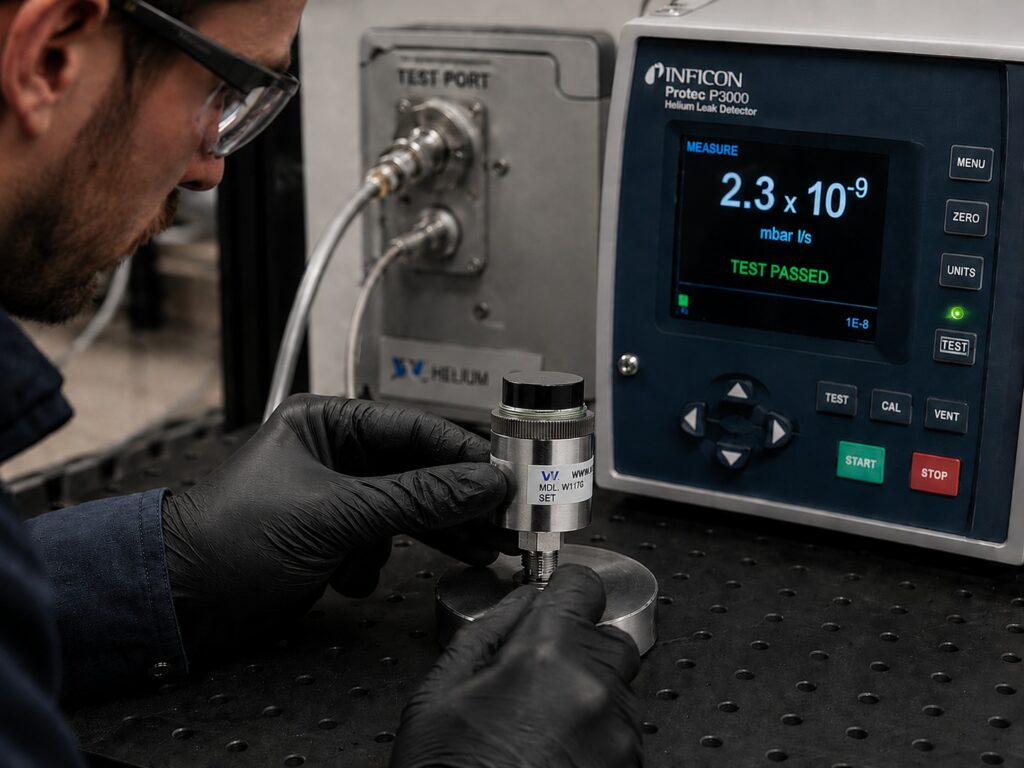
Because you cannot see a gas-level leak with the naked eye, hermeticity is verified using mass spectrometry, the gold standard in leakage detection.
Whitman sensors are helium leak-tested to a rate of 4 × 10⁻⁹ Std CC/sec. To put that number in perspective, a leak of that size is so small it would take approximately 30 years for a single cubic centimeter of air to pass through the seal.
Where Are Hermetically Sealed Sensors Used?
Hermetically sealed sensors are the fail-safe choice for industries where maintenance is difficult or failure is simply not an option.
- Aerospace & Defense Used in fuel systems and cabin pressure monitoring where sensors must survive extreme G-forces and vacuum conditions.
- Medical Radiography Protecting the cooling circuits of X-ray tubes from oil contamination and moisture ingress.
- Subsea Equipment Ensuring that high-pressure salt water cannot penetrate the electrical housing of deep-sea depth sensors.
- Hazardous Gas Analyzers Containing toxic gases like H₂S within the sample stream, protecting both the instrument and the operator.
About Whitman Controls and Industrial Control Solutions
Whitman Controls, part of Industrial Control Solutions, has been manufacturing precision vacuum, temperature, pressure, and liquid level switches and sensors for over 40 years. What began as a focused instrumentation manufacturer has grown into a trusted name across some of the most demanding industries in the world – aerospace, defense, semiconductor, medical and industrial automation.
As a Service-Disabled Veteran-Owned Small Business, Industrial Control Solutions was built on the same principles that define military service: tireless dedication, rigorous quality standards, and an unwavering commitment to the mission. That foundation isn’t marketing language, it shapes how we engineer every product, handle every order, and support every client relationship.
We don’t offer off-the-shelf compromises. Every sensor solution we build is configurable to your exact application, accounting for media environment, pressure range, temperature exposure, mounting constraints, and dozens of other specifications. If a standard product doesn’t meet your requirements, we build one that does and we back it with full documentation and traceability at every step.
Every product ships with full traceability documentation under our ISO 9001:2015 certification, giving customers confidence that internal processes, materials, and finished products have all met the highest standards of quality and regulatory compliance.
At Industrial Control Solutions, our most loyal clients have been with us for the entirety of our 40+ years in business. That kind of partnership isn’t accidental. It is the direct result of a commitment to delivering exactly what we promise; high-quality products, built to specification, backed by people who stand behind their work.
Our product portfolio spans four specialized USA-manufactured lines:
Whitman Controls – Vacuum, pressure, temperature, and liquid level switches engineered for precision and durability in extreme environments
Load Controls – Pump load controls, compact power sensors, fast-response load controllers, current sensors, and VFD-compatible solutions
Thomas Products – Flow switches, level switches, pump controls, multi-level switches, and visual indicators
Duro-sense – High-quality platinum and noble thermocouples, RTDs, and ISO 17025 calibrated wire
Frequently Asked Questions
Q. What is the difference between a hermetic seal and a standard O-ring seal in sensors?
A standard O-ring seal uses a compressible elastomer to block contaminants, but O-rings degrade over time; they dry out, crack, and release trapped gases. A hermetic seal, by contrast, is created by permanently fusing materials like glass and metal together, forming a bond with zero gas permeability that can last decades without degradation.
Q. How long does a hermetically sealed sensor last in a harsh environment?
A properly hermetically sealed sensor can last 20 to 30+ years in harsh environments. Whitman Controls validates this through helium leak testing at 4 × 10⁻⁹ Std CC/sec, a leak rate so low that it would take roughly 30 years for just one cubic centimeter of air to pass through.
Q. Why do semiconductor and vacuum processes specifically require hermetic sealing?
In processes like semiconductor ALD (Atomic Layer Deposition), even trace contamination from off-gassing can ruin an entire batch. Standard elastomer seals slowly release trapped gas molecules into the vacuum chamber. Hermetically sealed sensors eliminate this risk entirely, ensuring process purity.
Q. Is helium leak testing the industry standard for verifying hermetic seals?
Yes. Helium mass spectrometry leak testing is the globally recognized standard for verifying hermetic seal integrity. Helium is used because its small atomic size allows it to detect even the most microscopic leaks that other gases would not reveal.
Q. Can hermetically sealed sensors be used in both vacuum and high-pressure applications?
Absolutely. Hermetic seals are designed to perform under extreme pressure differentials in both directions, whether in deep-sea high-pressure saltwater environments or in near-perfect vacuum conditions like aerospace or semiconductor chambers. This bi-directional integrity is one of their key advantages over mechanical seals.