

In high-vacuum and high-purity industries such as semiconductor fabrication, medical device manufacturing, and aerospace, the integrity of a sensor’s seal is the difference between a successful process and a catastrophic failure. When a sensor is described as “helium leak tested,” it has undergone one of the most rigorous and sensitive leak detection processes available to modern engineering.
At Whitman Controls, our W117 Ultra Pure series is helium leak-tested to ensure it meets the highest standards of hermetic reliability.
Why Is Helium Used as a Tracer Gas?
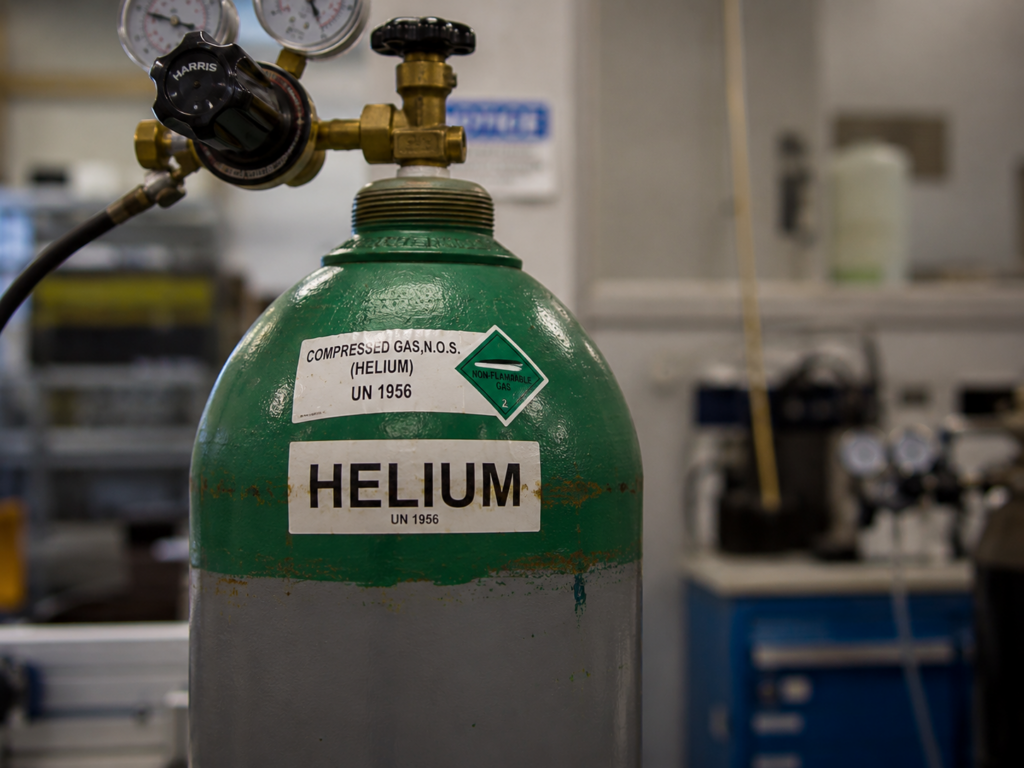
Helium is the gold standard for leak detection because of its unique physical properties. It is the second smallest molecule in existence (after hydrogen), non-flammable, and chemically inert.
- Atomic Size Because helium atoms are incredibly small, they can migrate through microscopic paths called micro-leaks that air, water, or even high-viscosity oils cannot penetrate.
- Low Atmospheric Concentration Helium is present in the Earth’s atmosphere at only about 5 parts per million (ppm). This low background level makes it easy for a mass spectrometer to detect even a single stray helium atom escaping a sensor.
- Inert Nature Unlike hydrogen, helium is completely safe to use in a laboratory or factory setting and will not react with the materials being tested.
How Is a Helium Leak Test Performed on Industrial Sensors?
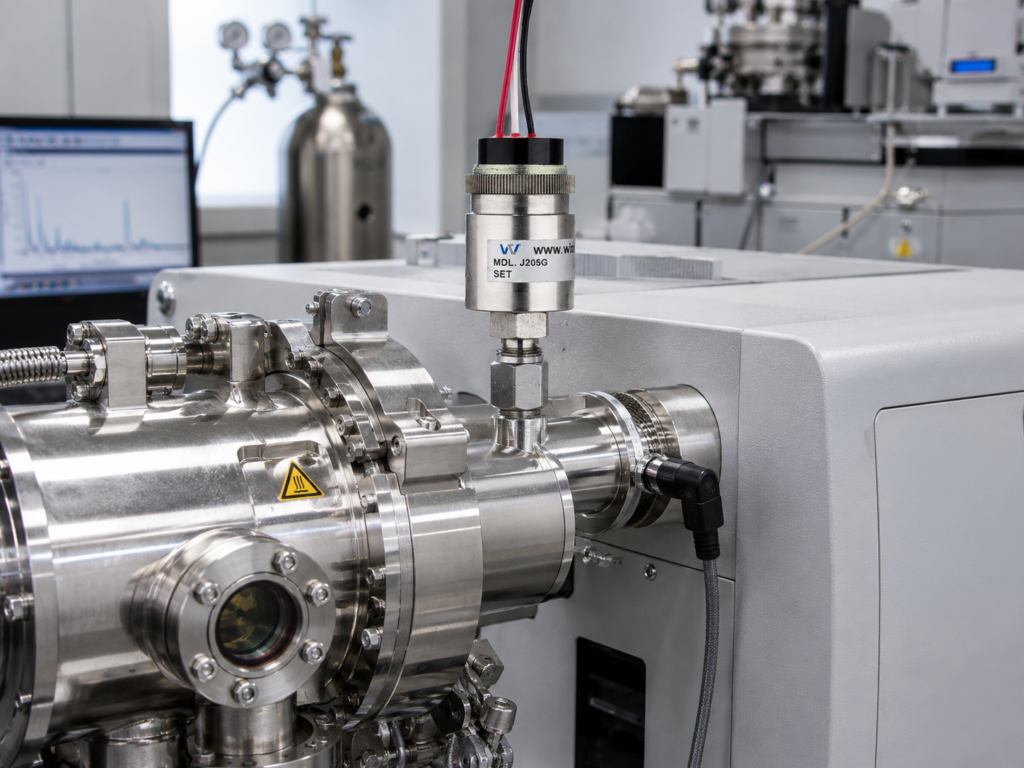
The most common method for testing industrial sensors is the Vacuum Out method, also known as the “Outside-In” test. It follows three precise steps:
- Step 1: Evacuation – The internal chamber of the pressure or vacuum switch is connected to a mass spectrometer and evacuated until a high vacuum is achieved.
- Step 2: Helium Spray – The exterior of the sensor, particularly the welded seams and process connections is bathed or sprayed with helium gas.
- Step 3: Detection – If there is any microscopic flaw in a weld or a material defect, the vacuum pulls helium atoms into the sensor. The mass spectrometer then counts these atoms to determine the leak rate.
What Does a Leak Rate of 4×10⁻⁹ Std CC/sec Actually Mean?
When a Whitman sensor is rated to 4×10⁻⁹ Std CC/sec, it indicates an incredibly high level of hermeticity. To put this in perspective, a typical high-quality O-ring seal has a leak rate somewhere in the 10⁻⁵ to 10⁻⁶ range. The Whitman Ultra Pure sensor operates at 10⁻⁹, the same standard held by implantable medical devices and high-end radiography equipment, where zero contamination is non-negotiable.
At that level, it would take roughly 30 years for a single cubic centimeter of air to leak into the sensor. That is not just a marginal improvement over standard industrial seals, it is several orders of magnitude more hermetic, making it the appropriate choice wherever process purity or personnel safety cannot be compromised.
Why Helium Leak Testing Matters for Your Application
- Preventing Contamination in Semiconductor Environments
In semiconductor “Ultra Pure” environments, a leak does not just mean a loss of pressure, it means outside air (oxygen and moisture) entering a vacuum chamber and potentially ruining a million-dollar batch of silicon wafers. - Ensuring Long-Term System Stability
Helium testing ensures that the sensor will not drift over time due to slow pressure equalization through a faulty seal. - Safety When Monitoring Hazardous Media
If a sensor is monitoring toxic or flammable gases like Hydrogen Sulfide (H₂S) or Hydrogen (H₂), a helium-tested seal provides the ultimate assurance that the gas will stay inside the process piping. - Aerospace and Vacuum Environment Reliability
At high altitudes, the pressure differential between a sensor’s internal cavity and the atmosphere is significant. Helium testing guarantees that the sensor remains hermetically sealed against the vacuum of space.
About Whitman Controls and Industrial Control Solutions
Whitman Controls, part of Industrial Control Solutions, has been manufacturing precision vacuum, temperature, pressure, and liquid level switches and sensors for over 40 years. What began as a focused instrumentation manufacturer has grown into a trusted name across some of the most demanding industries in the world – aerospace, defense, semiconductor, medical and industrial automation.
As a Service-Disabled Veteran-Owned Small Business, Industrial Control Solutions was built on the same principles that define military service: tireless dedication, rigorous quality standards, and an unwavering commitment to the mission. That foundation isn’t marketing language, it shapes how we engineer every product, handle every order, and support every client relationship.
We don’t offer off-the-shelf compromises. Every sensor solution we build is configurable to your exact application, accounting for media environment, pressure range, temperature exposure, mounting constraints, and dozens of other specifications. If a standard product doesn’t meet your requirements, we build one that does and we back it with full documentation and traceability at every step.
Every product ships with full traceability documentation under our ISO 9001:2015 certification, giving customers confidence that internal processes, materials, and finished products have all met the highest standards of quality and regulatory compliance.
At Industrial Control Solutions, our most loyal clients have been with us for the entirety of our 40+ years in business. That kind of partnership isn’t accidental. It is the direct result of a commitment to delivering exactly what we promise; high-quality products, built to specification, backed by people who stand behind their work.
Our product portfolio spans four specialized USA-manufactured lines:
Whitman Controls – Vacuum, pressure, temperature, and liquid level switches engineered for precision and durability in extreme environments
Load Controls – Pump load controls, compact power sensors, fast-response load controllers, current sensors, and VFD-compatible solutions
Thomas Products – Flow switches, level switches, pump controls, multi-level switches, and visual indicators
Duro-sense – High-quality platinum and noble thermocouples, RTDs, and ISO 17025 calibrated wire
Frequently Asked Questions
Q1: What is helium leak testing and how does it work?
Helium leak testing is a process where a sensor or component is evacuated using a mass spectrometer, then exposed to helium gas on the outside. Any microscopic defect allows helium atoms to pass through, and the spectrometer measures the leak rate. It is the most sensitive leak detection method available for industrial sensors.
Q2: What is a good helium leak rate for a pressure sensor?
A leak rate of 4×10⁻⁹ Std CC/sec is considered ultra-high purity grade, the same standard used in implantable medical devices. Standard industrial O-ring seals typically fall in the 10⁻⁵ to 10⁻⁶ range, which is significantly less hermetic.
Q3: Why is helium used instead of air or nitrogen for leak testing?
Helium atoms are among the smallest in existence, allowing them to pass through micro-leaks that air or nitrogen cannot. Helium is also naturally present in the atmosphere at only 5 ppm, making even trace amounts easy to detect with a mass spectrometer without false positives.
Q4: Do I need a helium leak-tested sensor for my application?
If your application involves semiconductor fabrication, hazardous or flammable gases, medical devices, or aerospace systems, a helium-tested sensor is strongly recommended. Any environment where a seal failure could cause contamination, safety risk, or system drift would benefit from the 10⁻⁹ leak rate specification.
Q5: Are Whitman Controls sensors certified for ultra-pure and medical-grade applications?
Yes. The Whitman Controls W117 Ultra Pure series is helium leak-tested to 4×10⁻⁹ Std CC/sec and manufactured under ISO 9001:2015 certified processes, making it suitable for semiconductor, medical, and aerospace applications where hermetic integrity is non-negotiable.