
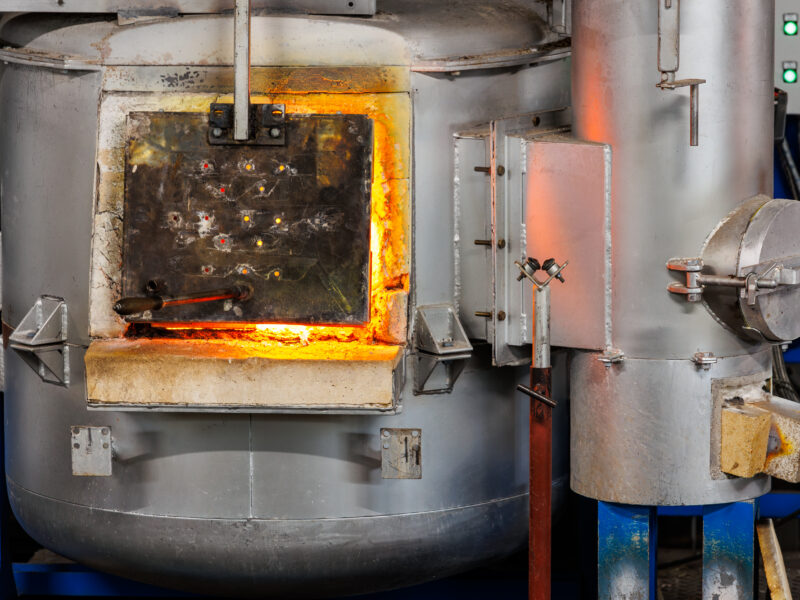
Calibrating a temperature switch, whether it’s a creep-action or snap-action thermostat is essential for maintaining the precise thermal profile your industrial oven demands. Without proper calibration, heating elements engage and disengage at the wrong points, compromising curing, drying, and heat-treating processes.
At Whitman Controls, we manufacture high-reliability temperature switches and thermostats built for long-term accuracy in high-temperature industrial environments. This guide walks you through the complete calibration process.
What Equipment Do You Need to Calibrate an Industrial Oven Temperature Switch?
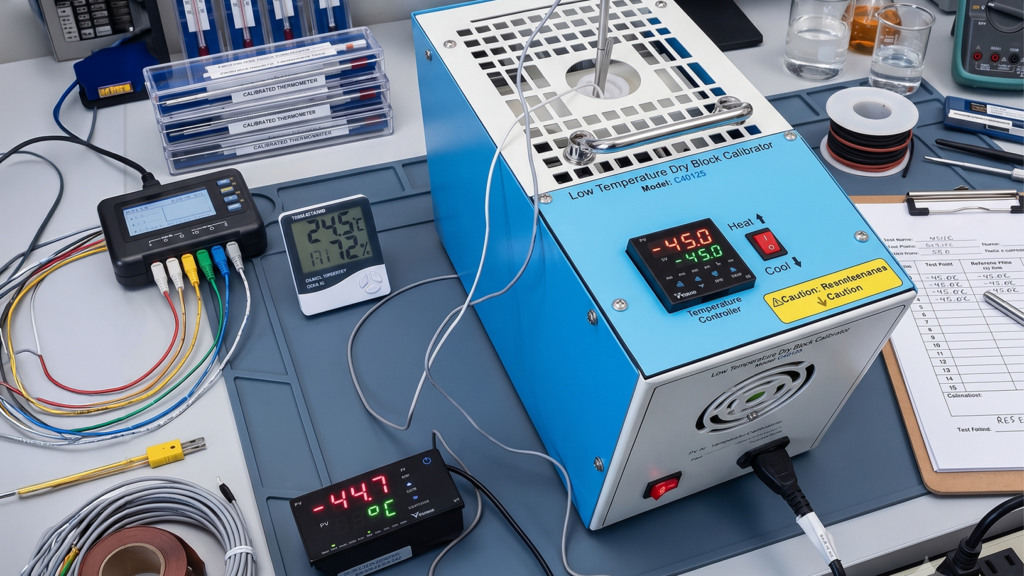
To calibrate a temperature probe, you must subject the sensing element to a known, stable temperature, one that can be verified by a secondary “master” thermometer or a dry block calibrator.
Step 1: Establish a Controlled Reference Environment
- Dry Block Calibrators are the gold standard for industrial oven probes. They provide a stable metallic well where you insert the probe and set a specific temperature digitally.
- Oil or Sand Baths work well for sensors with unusual shapes, since a stirred liquid bath ensures uniform heat distribution around the probe.
- NIST-Traceable Reference Thermometers always use a secondary, NIST-traceable thermometer (such as a high-accuracy RTD) to verify that the calibration environment is at the intended temperature.
Step 2: How Do You Find the Actuation and De-Actuation Points on a Temperature Switch?
Industrial oven switches are typically wired as NC (Normally Closed) to supply heat, or NO (Normally Open) to trigger a cooling fan or alarm. Identifying the “deadband”, the hysteresis between where the switch clicks on and where it clicks off is critical.
- Slow Temperature Ramp: Increase the reference block temperature slowly, at approximately 1°C per minute.
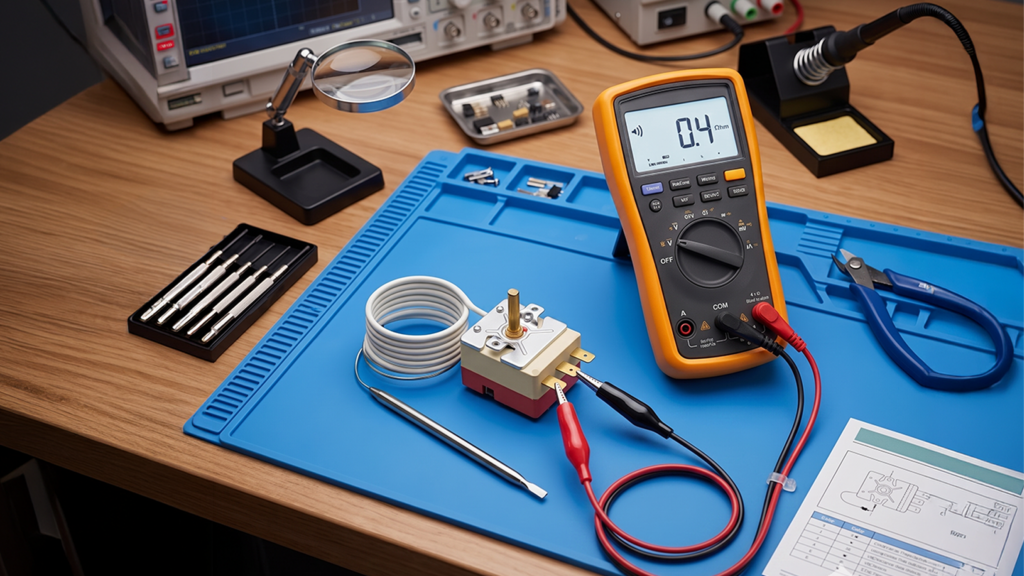
- Monitor Continuity: Use a multimeter set to Continuity or Ohms mode across the switch terminals.
- Record the Set Point: Note the exact temperature reading on your reference thermometer at the moment the switch changes state (for example, from Closed to Open).
- Check the Reset Point: Lower the temperature slowly and record where the switch returns to its original state.
Step 3: How to Physically Adjust a Field-Adjustable Temperature Switch
If the switch is not actuating at the correct temperature and it is a field-adjustable model, you will need to adjust the internal spring tension or contact gap.
- Adjustment Screw: Most industrial thermostats have a small internal screw. Turning it clockwise typically increases spring tension, requiring a higher temperature to actuate the switch.
- Iterative Verification: After each small adjustment, repeat the full ramp-up and ramp-down cycle. Calibration is an iterative process, it commonly takes two or three adjustments to hit the target set point precisely.
- Factory-Set Models: Many high-reliability switches, including Whitman creep-action thermostats are factory-set and sealed to prevent tampering or vibration-induced drift. These units cannot be field-adjusted. If they drift out of specification, they must be replaced.
What Are the Best Practices for Calibrating Temperature Switches in Oven Environments?
Modern industrial processes increasingly combine high-vacuum requirements with extreme thermal loads. Selecting the right sensor is not a matter of preference, it is a matter of system safety and process integrity.
- How Does Thermal Lag Affect Calibration Accuracy?
In large industrial ovens, the temperature at the probe location can differ meaningfully from the temperature at the oven’s centre. Position your probe in a high-airflow area to minimise thermal lag and improve reading accuracy. - Do Industrial Ovens Cause Thermostat Contact Chatter?
Ovens equipped with heavy circulation fans generate significant vibration. Contact chatter, where vibration causes the switch contacts to bounce leads to premature fatigue and false readings. Always specify a switch rated for high-vibration environments. - What Type of Lead Wire Should Be Used Inside an Industrial Oven?
Standard wire insulation degrades rapidly at oven temperatures. Always use high-temperature PTFE or fibreglass-insulated lead wires for any sensor entering the oven cavity.
About Whitman Controls and Industrial Control Solutions
Whitman Controls, part of Industrial Control Solutions, has been manufacturing precision vacuum, temperature, pressure, and liquid level switches and sensors for over 40 years. What began as a focused instrumentation manufacturer has grown into a trusted name across some of the most demanding industries in the world – aerospace, defense, semiconductor, medical and industrial automation.
As a Service-Disabled Veteran-Owned Small Business, Industrial Control Solutions was built on the same principles that define military service: tireless dedication, rigorous quality standards, and an unwavering commitment to the mission. That foundation isn’t marketing language, it shapes how we engineer every product, handle every order, and support every client relationship.
We don’t offer off-the-shelf compromises. Every sensor solution we build is configurable to your exact application, accounting for media environment, pressure range, temperature exposure, mounting constraints, and dozens of other specifications. If a standard product doesn’t meet your requirements, we build one that does and we back it with full documentation and traceability at every step.
Every product ships with full traceability documentation under our ISO 9001:2015 certification, giving customers confidence that internal processes, materials, and finished products have all met the highest standards of quality and regulatory compliance.
At Industrial Control Solutions, our most loyal clients have been with us for the entirety of our 40+ years in business. That kind of partnership isn’t accidental. It is the direct result of a commitment to delivering exactly what we promise; high-quality products, built to specification, backed by people who stand behind their work.
Our product portfolio spans four specialized USA-manufactured lines:
Whitman Controls – Vacuum, pressure, temperature, and liquid level switches engineered for precision and durability in extreme environments
Load Controls – Pump load controls, compact power sensors, fast-response load controllers, current sensors, and VFD-compatible solutions
Thomas Products – Flow switches, level switches, pump controls, multi-level switches, and visual indicators
Duro-sense – High-quality platinum and noble thermocouples, RTDs, and ISO 17025 calibrated wire
Frequently Asked Questions
Q: What is the best tool for calibrating an industrial oven temperature probe?
A: A dry block calibrator is the gold standard. It provides a stable, digitally controlled metallic well to insert the probe and verify actuation points accurately. Always pair it with a NIST-traceable reference thermometer to confirm the actual temperature at the probe tip.
Q: What is the difference between the actuation point and de-actuation point on a temperature switch?
A: The actuation point is the temperature at which the switch changes state for example, from Closed to Open. The de-actuation (or reset) point is the temperature at which it returns to its original state. The gap between these two points is called the deadband or hysteresis.
Q: Can all industrial temperature switches be field-adjusted?
A: No. Many high-reliability switches, including factory-sealed creep-action thermostats, cannot be field-adjusted. These are sealed to prevent drift from vibration or tampering. If they move out of specification, they must be replaced rather than recalibrated on-site.
Q: Why is my temperature probe reading differently from the oven’s actual centre temperature?
A: This is called thermal lag. In large industrial ovens, the temperature at the probe location can differ from the centre of the oven cavity. Positioning the probe in a high-airflow zone reduces this lag and improves calibration accuracy.
Q: What type of wire insulation is safe to use inside an industrial oven?
A: Standard wire insulation breaks down at high oven temperatures. You should use high-temperature PTFE (polytetrafluoroethylene) or fibreglass-insulated lead wires for any sensor or thermocouple entering the oven cavity.