

In industrial process automation, selecting the correct method for monitoring liquid or solid levels is critical for operational efficiency and safety. While both technologies serve the same fundamental goal, tracking media within a vessel; they deliver fundamentally different types of data and serve distinct control purposes.
Point level sensing acts as a simple status indicator. Continuous level measurement functions as a high-resolution, real-time data stream. At Whitman Controls, we offer a diversified portfolio of both technologies to help you unlock advanced performance management capabilities for your specific application.
What Is Point Level Sensing? Discrete Limit Control Explained
Point level sensing detects the presence or absence of media at a specific, predetermined elevation inside a vessel. These sensors deliver a discrete on/off signal, functioning much like a light switch and are ideal for applications where you only need to know when a tank has reached a critical high or low threshold.
Key Characteristics of Point Level Sensors
- Binary Output: These devices use electrical contacts that open or close once the media reaches the sensor’s position, triggering a simple true/false signal in your control system.
- Safety and Interlocks: Point level sensors are frequently used for permissive starts, ensuring a pump or system only operates when liquid is verifiably present, preventing dry-run damage.
- Simple Logic for Emergency Cut-Outs: They are excellent for emergency safety cut-outs, automatically stopping a process cycle if a tank runs dry or overflows.
- Featured Products:
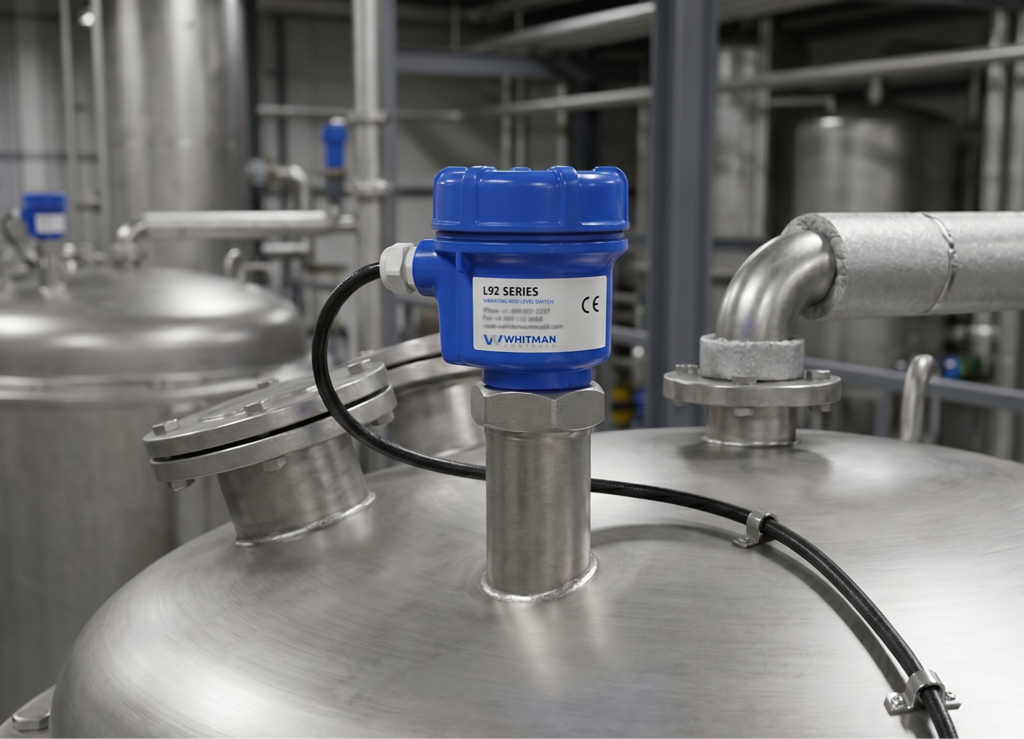
- L20 Series – Side-mounted float switches for straightforward high/low level limit detection
- L90 / L92 Series – Vibrating fork switches for reliable point detection in liquids and bulk solids
What Is Continuous Level Measurement? Real-Time Process Insight
Continuous level measurement provides a constant analog electrical output proportional to the actual media level across the entire span of the vessel. This gives operators and automated platforms real-time insight into exact volume remaining, without manual gauging.
Key Characteristics of Continuous Level Transmitters
- Analog Data Stream: These transmitters output standard industry signals such as 4–20mA or 0–10V, which connect directly to downstream displays, PLCs, and HMIs for seamless integration.
- Predictive Analytics and Leak Detection: Continuous data enables systems to trend levels over time, which is critical for early leak detection and building effective predictive maintenance models.
- Multi-Stage Operational Control: This technology supports multi-stage level control to handle wide heat load swings such as those encountered in data center refrigeration systems.
- Featured Products:
Point Level Sensing vs. Continuous Measurement: How to Choose the Right Solution
The decision between point and continuous sensing depends on the complexity of your control loop and the specific requirements of your application.
- Cost vs. Control Complexity
Point level sensing is often the more economical choice for simple alarm states or idle-protection logic. Continuous level measurement, however, is necessary when modulating pump speeds through variable frequency drives (VFDs) or managing multi-stage process flows. - Industrial Use Cases
Continuous level transmitters are essential in precision-critical environments; for example, ozonated water control in semiconductor manufacturing, where precise contact time directly affects product quality and yield. - Redundancy and Safety Architecture
Many high-risk systems use a continuous level transmitter for primary real-time monitoring while point level switches serve as a redundant safety hedge, triggering alarms or shutdowns if the primary transmitter fails or reads outside safe bounds. - Maintenance Accessibility
External continuous sensors, such as those installed in standpipes, allow for maintenance and stable readings without requiring access to or entry into the main receiver body, reducing downtime and improving safety compliance.
About Whitman Controls and Industrial Control Solutions
Whitman Controls, part of Industrial Control Solutions, has been manufacturing precision vacuum, temperature, pressure, and liquid level switches and sensors for over 40 years. What began as a focused instrumentation manufacturer has grown into a trusted name across some of the most demanding industries in the world – aerospace, defense, semiconductor, medical and industrial automation.
As a Service-Disabled Veteran-Owned Small Business, Industrial Control Solutions was built on the same principles that define military service: tireless dedication, rigorous quality standards, and an unwavering commitment to the mission. That foundation isn’t marketing language, it shapes how we engineer every product, handle every order, and support every client relationship.
We don’t offer off-the-shelf compromises. Every sensor solution we build is configurable to your exact application, accounting for media environment, pressure range, temperature exposure, mounting constraints, and dozens of other specifications. If a standard product doesn’t meet your requirements, we build one that does and we back it with full documentation and traceability at every step.
Every product ships with full traceability documentation under our ISO 9001:2015 certification, giving customers confidence that internal processes, materials, and finished products have all met the highest standards of quality and regulatory compliance.
At Industrial Control Solutions, our most loyal clients have been with us for the entirety of our 40+ years in business. That kind of partnership isn’t accidental. It is the direct result of a commitment to delivering exactly what we promise; high-quality products, built to specification, backed by people who stand behind their work.
Our product portfolio spans four specialized USA-manufactured lines:
Whitman Controls – Vacuum, pressure, temperature, and liquid level switches engineered for precision and durability in extreme environments
Load Controls – Pump load controls, compact power sensors, fast-response load controllers, current sensors, and VFD-compatible solutions
Thomas Products – Flow switches, level switches, pump controls, multi-level switches, and visual indicators
Duro-sense – High-quality platinum and noble thermocouples, RTDs, and ISO 17025 calibrated wire
Frequently Asked Questions
1. What is the difference between continuous level measurement and point level sensing?
Point level sensing tells you if the media has crossed a specific threshold, it outputs a simple on/off signal. Continuous level measurement tells you how much media is present at all times, delivering a real-time analog signal proportional to the actual level across the full vessel height. One is a status check; the other is a live data stream.
2. When should I use a continuous level transmitter instead of a point level switch?
Use a continuous transmitter when your process requires proportional control such as modulating a pump via a VFD, managing multi-stage processes, detecting slow leaks through level trending, or meeting precision requirements in semiconductor or chemical manufacturing. For simple high/low alarms, a point level switch is usually sufficient and more economical.
3. Can point level switches and continuous transmitters work together in the same system?
Yes, and it’s a common best practice in safety-critical applications. The continuous transmitter handles primary real-time monitoring and process control, while point level switches act as independent hardwired backups, triggering shutdowns if the transmitter fails or goes offline for maintenance.
4. What output signal does a continuous level transmitter use?
Most continuous level transmitters output a 4–20mA analog signal, 4mA indicating empty, 20mA indicating full. Some also support 0–10V or HART protocol. The 4–20mA format is preferred in industrial settings because it resists electrical noise over long cable runs and detects broken wire faults through its live-zero design.
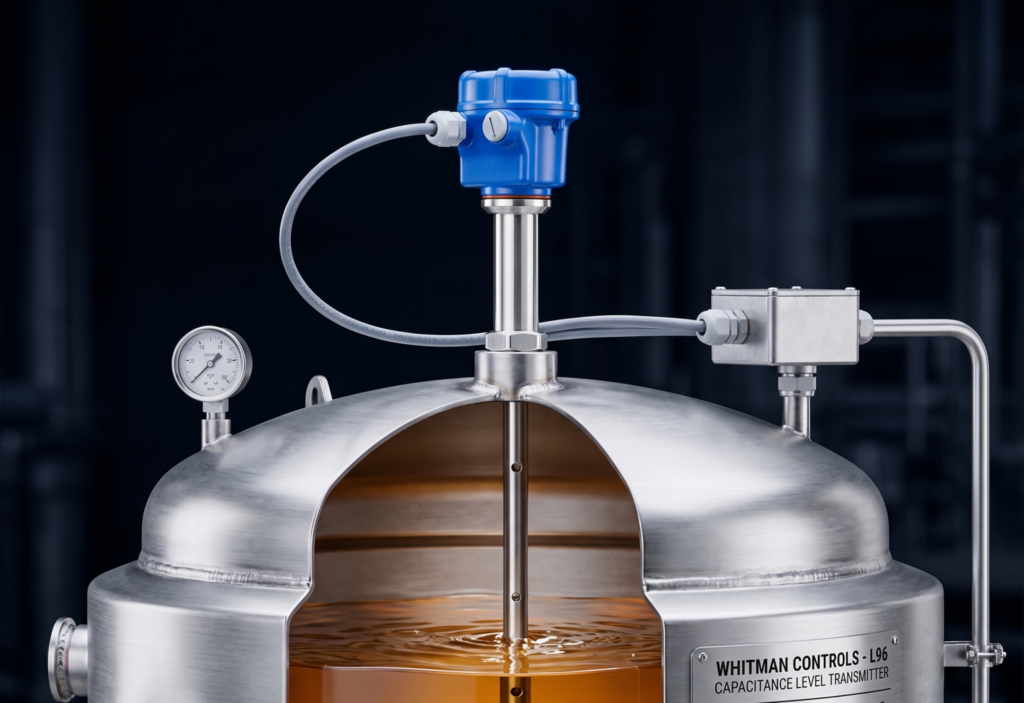
5. What is the difference between the L95 Hydrostatic and L96 Capacitance Level Transmitter?
The L95 measures liquid pressure at the sensor point, ideal for clean liquids with a stable specific gravity. The L96 detects changes in electrical capacitance as media rises or falls, making it suitable for liquids, slurries, granular solids, and non-conductive media across varied vessel geometries. Choose L95 for simplicity; choose L96 for versatility.