
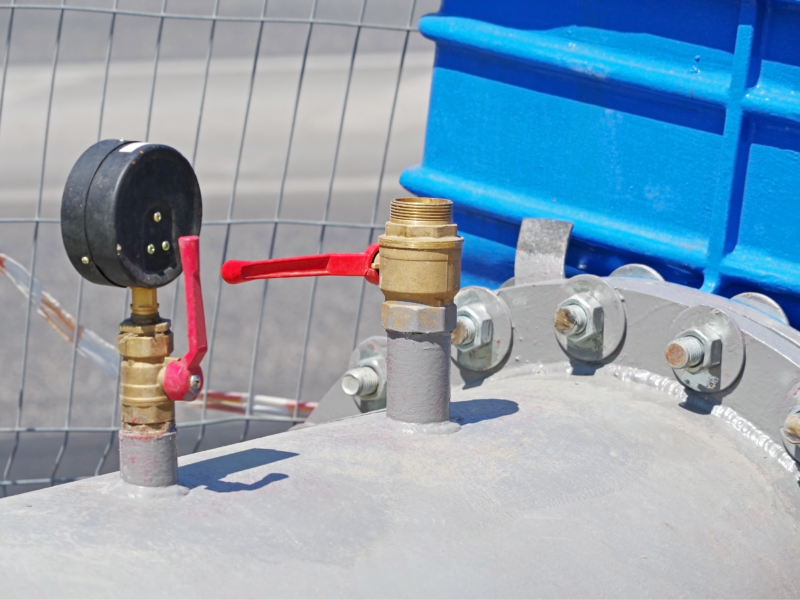
Installing a level switch in a pressurized vessel requires careful consideration of the tank’s internal environment and the physical limits of the sensor. Pressurized tanks are common in thermal liquid processing and central plant utilities, often containing hazardous or high-temperature media. Getting the installation right means matching the instrument to the specific pressure, temperature, and media conditions of your system; a mismatch can compromise both accuracy and safety.
Which Sensing Technology Suits a Pressurized Tank?
The right sensing technology depends on your tank’s pressure, media type, and whether the sensor needs to contact the liquid directly. Here are the primary options:

- Differential Pressure Reference – These models are designed specifically for pressurized tanks. They measure the airspace and liquid space separately to derive true level, making them one of the most reliable choices for closed, pressurized systems.
- Capacitance Level Transmitters – Sensors like the Whitman L96 Series are ideal for hazardous pressurized materials such as ammonia. They detect the varying dielectric constant between liquid and gas without needing to enter the main receiver body, particularly when installed in an external standpipe.
- Crush Pressure Ratings – For float-style switches, always verify the crush pressure rating before installation. This is the maximum pressure a float can withstand before deforming, and it varies based on materials such as 316 Stainless Steel or Polypropylene.
- Ultrasonic Sensors – Standard non-contact ultrasonic sensors measure through air and are not always suitable for pressurized environments. Specialized housings, such as the ToughSonic Chem series, are required when using ultrasonic sensors in pressurized chemical tanks.
How Are Level Switches Installed in Pressurized Systems?
Proper mounting and sealing are critical to preventing leaks and ensuring long-term sensor stability.
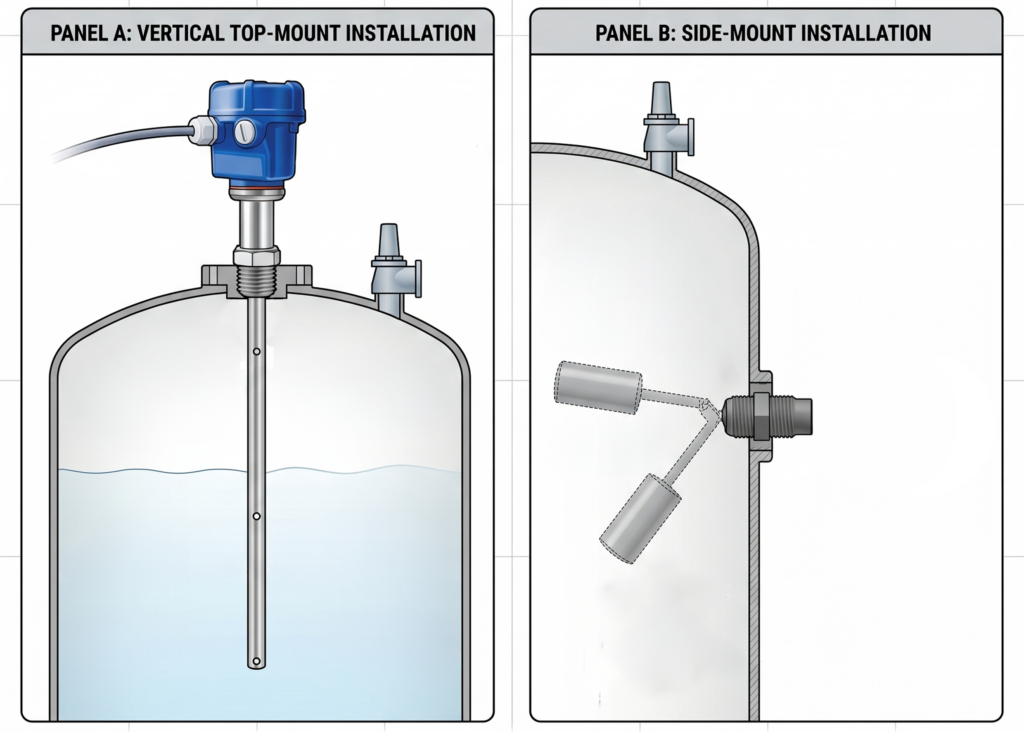
- Vertical Mounting – Single station switches with NPT mounting, such as the L40 or L60 Series, are typically installed vertically through the top or bottom of the tank. This is the most straightforward configuration for direct tank entry.
- Side-Mount Installation – For tanks where the interior must remain free of fixed objects, side-mounted switches like the L20/L25 Series are installed through the sidewall using NPT or flanged connections.
- Red Seal Protection – Whitman’s Red Seal potting provides assurance that no additional special liquid or vapor seals are required at the point of installation, simplifying the setup process.
- Inclination Limits – Most vertical switches will operate normally even if the tank is inclined up to 30 degrees, providing installation flexibility in non-standard environments.
Safety and Maintenance in Pressurized Environments
Installing instrumentation in a pressurized environment carries inherent risks. Strict adherence to technical specifications is non-negotiable.

- Do Not Exceed Rated Limits – Never subject the instrument to temperatures, pressures, or electrical loads beyond those listed on the nameplate or in the technical literature. Exceeding these limits can cause instrument failure or create a hazardous condition.
- Account for Surge Pressures – When calculating required pressure ratings, always factor in possible system surge pressures and their frequency. Nameplate ratings must accommodate peak conditions, not just steady-state operation.
- Contaminant Management – Excessive contaminants in the fluid can inhibit float operation. In pressurized systems, occasional wipe-downs may be necessary, but only when the system can be safely depressurized for maintenance.
- No Field Repairs – Level switches must not be field-repaired. Any physical damage to the instrument may render it unserviceable and dangerous in a high-pressure environment. Always replace a damaged unit through the manufacturer.
About Whitman Controls and Industrial Control Solutions
Whitman Controls, part of Industrial Control Solutions, has been manufacturing precision vacuum, temperature, pressure, and liquid level switches and sensors for over 40 years. What began as a focused instrumentation manufacturer has grown into a trusted name across some of the most demanding industries in the world – aerospace, defense, semiconductor, medical and industrial automation.
As a Service-Disabled Veteran-Owned Small Business, Industrial Control Solutions was built on the same principles that define military service: tireless dedication, rigorous quality standards, and an unwavering commitment to the mission. That foundation isn’t marketing language, it shapes how we engineer every product, handle every order, and support every client relationship.
We don’t offer off-the-shelf compromises. Every sensor solution we build is configurable to your exact application, accounting for media environment, pressure range, temperature exposure, mounting constraints, and dozens of other specifications. If a standard product doesn’t meet your requirements, we build one that does and we back it with full documentation and traceability at every step.
Every product ships with full traceability documentation under our ISO 9001:2015 certification, giving customers confidence that internal processes, materials, and finished products have all met the highest standards of quality and regulatory compliance.
At Industrial Control Solutions, our most loyal clients have been with us for the entirety of our 40+ years in business. That kind of partnership isn’t accidental. It is the direct result of a commitment to delivering exactly what we promise; high-quality products, built to specification, backed by people who stand behind their work.
Our product portfolio spans four specialized USA-manufactured lines:
Whitman Controls – Vacuum, pressure, temperature, and liquid level switches engineered for precision and durability in extreme environments
Load Controls – Pump load controls, compact power sensors, fast-response load controllers, current sensors, and VFD-compatible solutions
Thomas Products – Flow switches, level switches, pump controls, multi-level switches, and visual indicators
Duro-sense – High-quality platinum and noble thermocouples, RTDs, and ISO 17025 calibrated wire
Frequently Asked Questions
1. What is crush pressure for a float switch?
Crush pressure is the maximum internal pressure a float can withstand before it deforms or collapses. The rating varies depending on the float material, 316 Stainless Steel floats handle higher pressures than Polypropylene. Always verify the crush pressure rating against your system’s maximum operating and surge pressures before specifying a float-style switch.
2. Can ultrasonic sensors be used in pressurized tanks?
Standard ultrasonic sensors are not designed for pressurized environments. Specialized versions, such as the ToughSonic Chem series with appropriate housings, can be used in pressurized chemical tanks, but this must be confirmed with the manufacturer for your specific application.
3. What is the maximum inclination for a vertical level switch?
Most vertical level switches will function normally when the tank is inclined up to 30 degrees from vertical. Beyond this, performance may be affected and the manufacturer should be consulted.
4. When should a capacitance transmitter be used instead of a float switch?
Capacitance transmitters are the preferred choice for hazardous or aggressive media such as ammonia, where a float-style switch may not be compatible with the fluid chemistry or where installation in an external standpipe is preferred to avoid penetrating the main vessel body.
5. Does Whitman Controls’ Red Seal eliminate the need for additional seals?
Yes. The Red Seal potting used on Whitman Controls instruments is designed so that no additional special liquid or vapor seals are required at the installation point, reducing complexity and potential leak paths.