

Deciding whether to recalibrate or replace a pressure switch is one of the most consequential maintenance calls in any industrial facility. Get it wrong in either direction and you’re either overspending on unnecessary parts or gambling with the safety of a system that may cost far more to repair if it fails.
At Whitman Controls, we treat every pressure switch as a safety device first. When its internal integrity is in doubt, recalibration is not a fix. It is a delay. This guide walks through the four primary indicators that tell you a switch has crossed the line from “needs adjustment” to “needs replacement.”
1. Physical Damage to the Sensing Element
The diaphragm or piston inside a pressure switch is the component that converts pressure into mechanical movement. If it is compromised, no amount of calibration will restore reliable performance.
Signs the sensing element has failed:
- Visible fluid leakage – If process media (oil, water, or gas) is escaping through the weep holes or into the electrical housing, the internal seal has failed. This is a replacement-immediately situation. There is no field fix for a breached seal.
- Post-overpressure deformation – When a system spike pushes a switch beyond its rated proof pressure, the diaphragm can permanently stretch. A deformed diaphragm has a different spring rate and will produce unpredictable set point behaviour going forward.
- Chemical degradation – Discolouration, brittleness, or pitting on the metal or elastomer surfaces indicates that the process media is chemically incompatible with the switch materials. Recalibrating will not halt ongoing material breakdown.
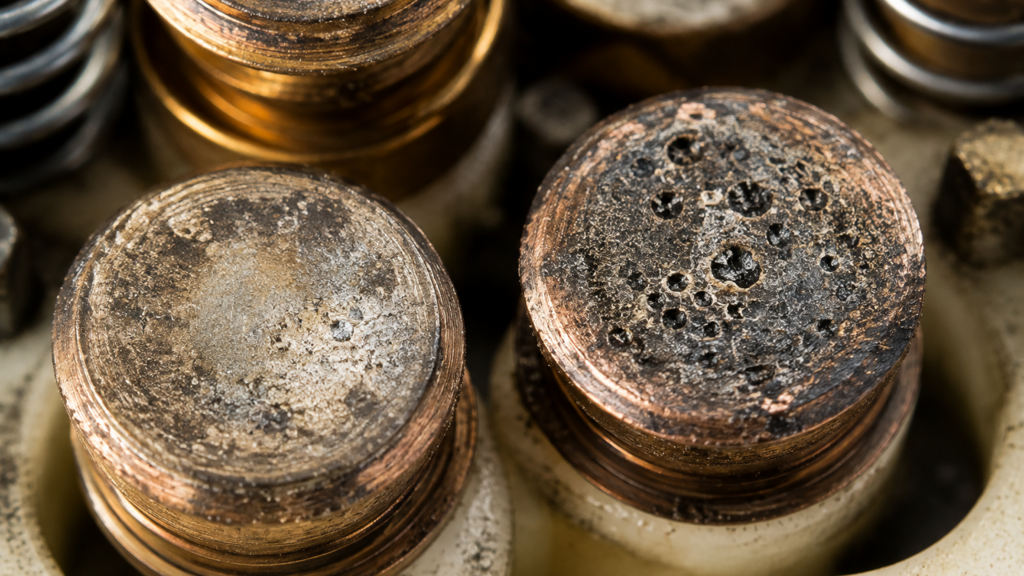
2. Worn or Pitted Electrical Contacts
Every actuation event creates a small electrical arc. Across hundreds of thousands of cycles, this gradually erodes the contact surface.
What worn contacts look like in practice:
- High contact resistance – Measure across the closed contacts with a multimeter. A reading consistently above 1-2 ohms signals pitting or oxidisation that will only worsen.
- Intermittent electrical signal – If the switch produces a clean mechanical click but the circuit output is erratic or delayed, the internal leaf springs or contact surfaces are fatigued.
- Wrong contact material for the application – Silver contacts in low-current dry circuits develop a non-conductive oxide layer over time. While temporary cleaning may restore function briefly, the underlying problem will recur. The correct long-term solution is replacing the unit with a gold-plated contact model rated for dry-circuit use.
3. Excessive or Accelerating Set Point Drift
Some drift is normal over a long service life. Rapid or repeated drift is a mechanical warning sign, not a calibration problem.
Three drift patterns that indicate replacement:
- Repeated recalibration cycles – If the same switch requires adjustment every few weeks to stay within spec, the internal range spring has lost its tensile memory and will not hold any adjustment reliably.
- Expanding or contracting deadband – If the gap between the trip point and the reset point is shifting over time, internal friction or spring fatigue is at play, not a simple set point issue.
- Adjustment at mechanical limits – When the adjustment screw is at its maximum or minimum travel and the switch is still not tripping correctly, the internal mechanics have moved outside their design envelope. Further calibration is not possible.
4. Age, Environment, and Design Life
Cycle count is only one dimension of lifespan. Time and operating environment matter equally.
Design life considerations:
- Material degradation over time – After ten to fifteen years of service, internal O-rings and polymer components become brittle regardless of how many cycles they have accumulated. This is a time-based failure mode, not a usage-based one.
- Accelerated aging in harsh environments – Switches in high-vibration applications (engine-mounted) or corrosive environments (marine, offshore) age far faster than their rated cycle count suggests. In these cases, proactive replacement every three to five years is typically more economical than a single unplanned failure event.
- The replacement cost argument – If the switch is protecting a $20,000 pump or a critical safety circuit, the cost of a new $100–$200 switch is negligible compared to the risk of a failure.
About Whitman Controls and Industrial Control Solutions
Whitman Controls, part of Industrial Control Solutions, has been manufacturing precision vacuum, temperature, pressure, and liquid level switches and sensors for over 40 years. What began as a focused instrumentation manufacturer has grown into a trusted name across some of the most demanding industries in the world – aerospace, defense, semiconductor, medical and industrial automation.
As a Service-Disabled Veteran-Owned Small Business, Industrial Control Solutions was built on the same principles that define military service: tireless dedication, rigorous quality standards, and an unwavering commitment to the mission. That foundation isn’t marketing language, it shapes how we engineer every product, handle every order, and support every client relationship.
We don’t offer off-the-shelf compromises. Every sensor solution we build is configurable to your exact application, accounting for media environment, pressure range, temperature exposure, mounting constraints, and dozens of other specifications. If a standard product doesn’t meet your requirements, we build one that does and we back it with full documentation and traceability at every step.
Every product ships with full traceability documentation under our ISO 9001:2015 certification, giving customers confidence that internal processes, materials, and finished products have all met the highest standards of quality and regulatory compliance.
At Industrial Control Solutions, our most loyal clients have been with us for the entirety of our 40+ years in business. That kind of partnership isn’t accidental. It is the direct result of a commitment to delivering exactly what we promise; high-quality products, built to specification, backed by people who stand behind their work.
Our product portfolio spans four specialized USA-manufactured lines:
Whitman Controls – Vacuum, pressure, temperature, and liquid level switches engineered for precision and durability in extreme environments
Load Controls – Pump load controls, compact power sensors, fast-response load controllers, current sensors, and VFD-compatible solutions
Thomas Products – Flow switches, level switches, pump controls, multi-level switches, and visual indicators
Duro-sense – High-quality platinum and noble thermocouples, RTDs, and ISO 17025 calibrated wire
Frequently Asked Questions
Q1: How do I know if my pressure switch needs recalibration or replacement?
If the switch shows physical damage (leaking seals, corroded contacts, deformed diaphragm), requires repeated recalibration within short intervals, or has been in service for 10-15 years in a harsh environment, replacement is the more reliable option. Recalibration is only appropriate when the mechanical internals are structurally sound.
Q2: What is proof pressure in a pressure switch?
Proof pressure is the maximum pressure a switch can be exposed to without permanent mechanical damage. If a system spike exceeds this threshold, the diaphragm may be permanently deformed, making the switch unreliable even after recalibration.
Q3: Why is my pressure switch tripping inconsistently?
Inconsistent actuation usually points to worn or oxidised electrical contacts, a fatigued internal spring, or a deformed sensing element. If the mechanical click is present but the electrical output is intermittent, the contacts are the most likely cause.
Q4: How long does an industrial pressure switch last?
High-quality switches such as the Whitman P117 series are rated for one million or more actuation cycles. However, time-based degradation of O-rings and polymer components typically becomes a factor after 10-15 years, regardless of cycle count. Harsh environments can reduce effective lifespan to 3-5 years.
Q5: What is the difference between silver and gold contacts in a pressure switch?
Silver contacts perform well in higher-current applications but develop a non-conductive oxide layer in low-power dry-circuit applications, leading to intermittent or failed actuation over time. Gold-plated contacts resist oxidation and are the correct choice for dry-circuit use.