

In safety-critical systems such as emergency shutdowns for boilers, over-pressure protection in hydrogen fuel cells, or low-level cutoffs in hydraulic power units, the choice between a mechanical switch and an electronic sensor (transmitter) is a fundamental engineering decision. While electronic sensors offer high-resolution data, mechanical switches remain a staple in safety architectures due to their “passive” reliability. At Whitman Controls, we provide both technologies, allowing OEMs to build redundant “fail-safe” systems.
Why Mechanical Switches Still Hold Their Ground
Passive by Design, Reliable by Nature
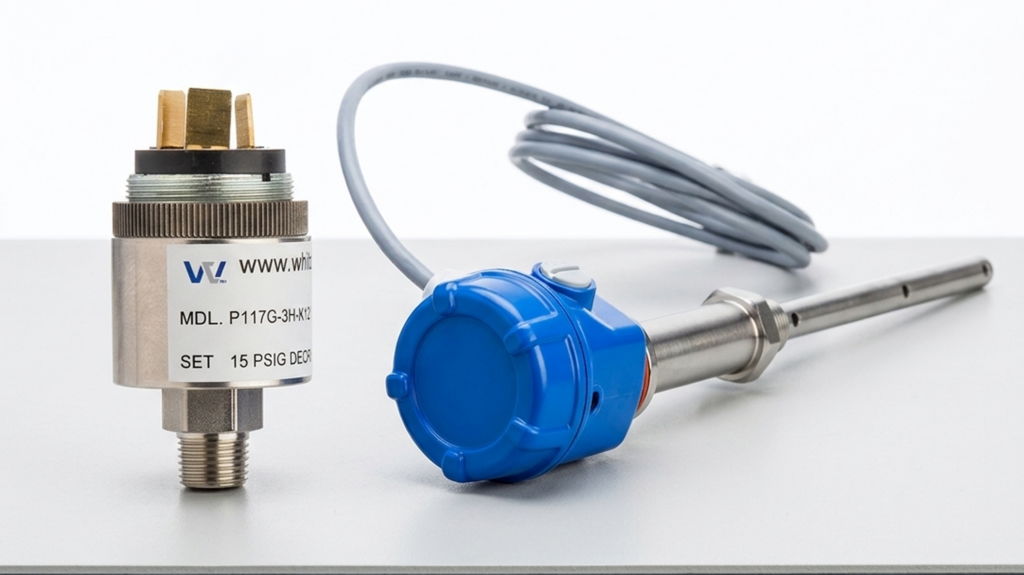
A mechanical pressure or level switch is a “passive” device. It does not require external power to monitor the system; the process media itself provides the energy required to move the diaphragm and trip the electrical contact.
- Immunity to Power Failure: In a total blackout, a mechanical switch can still trigger a hard-wired emergency stop or a battery-backed alarm.
- Simplicity and “Hard-Wired” Logic: Because there is no microprocessor or software involved, there is no risk of a “firmware crash” or electromagnetic interference (EMI) causing a digital glitch.
- High Current Handling: Mechanical switches can often drive a motor starter or a large solenoid directly, whereas electronic sensors usually require an intermediate relay.
- The “Proof of Concept”: Many safety standards (like SIL or SIL2) favor mechanical switches as a “Final Element” because their failure modes are well-understood and predictable.
Where Electronic Sensors Bring More to the Table
Continuous Data, Smarter Decisions
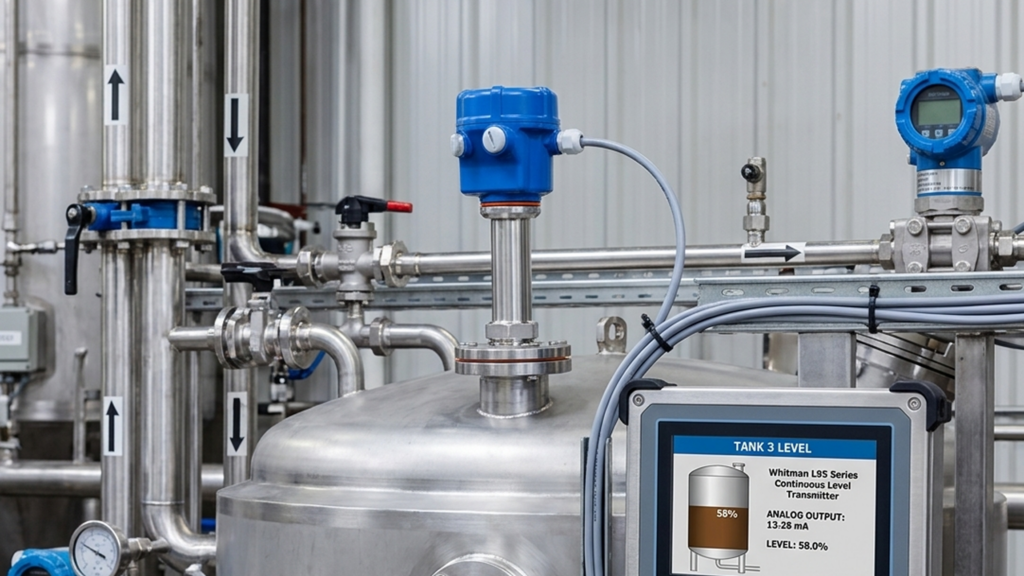
Electronic transmitters (like the Whitman L95 series) provide a continuous analog (4–20mA) or digital signal. They don’t just tell you if a limit has been reached; they tell you how fast the system is approaching that limit.
- High Resolution and Accuracy: Electronic sensors can detect minute changes in pressure or level, providing the data needed for Predictive Maintenance (PdM).
- Self-Diagnostics: “Smart” sensors can perform internal health checks. If a wire is cut or a sensing element fails, the sensor can send an “Error” signal to the PLC, whereas a mechanical switch may fail “silently.”
- Adjustable Logic: With an electronic sensor, the “trip point” can be changed in software without someone having to physically adjust a screw on the machine.
- Advanced Filtering: Electronic sensors can use digital algorithms to ignore “nuisance” spikes or vibration that might cause a mechanical switch to chatter.
Head-to-Head: Choosing the Right Technology
A Quick Reference for Safety Engineers
| Feature | Mechanical Switch | Electronic Sensor |
| Power Required | No (Passive) | Yes (Active) |
| Data Type | On/Off (Discrete) | Continuous (Analog/Digital) |
| Failure Mode | Mechanical Fatigue | Component/Software Glitch |
| EMI/RFI Sensitivity | Very Low | Moderate to High |
| Maintenance | Periodic Calibration | Calibration & Firmware |
| Best Use Case | Emergency Stop / Fail-Safe | Process Control / Monitoring |
Building the Safest System: Using Both Together
Redundancy and Diversity as a Strategy
In the most critical systems, engineers often use a “Diversity Strategy”, combining both technologies to eliminate common-cause failures.
- Primary Monitoring: Use an electronic sensor for real-time process control and data logging.
- Secondary Backup: Use a mechanical switch (like the Whitman P117) as a “last line of defense” hard-wired directly to the fuel shut-off valve or pump power.
- Result: This ensures that if the PLC crashes or the power fails, the mechanical switch will still protect the equipment and personnel.
About Whitman Controls and Industrial Control Solutions
Whitman Controls, part of Industrial Control Solutions, has been manufacturing precision vacuum, temperature, pressure, and liquid level switches and sensors for over 40 years. What began as a focused instrumentation manufacturer has grown into a trusted name across some of the most demanding industries in the world – aerospace, defense, semiconductor, medical and industrial automation.
As a Service-Disabled Veteran-Owned Small Business, Industrial Control Solutions was built on the same principles that define military service: tireless dedication, rigorous quality standards, and an unwavering commitment to the mission. That foundation isn’t marketing language, it shapes how we engineer every product, handle every order, and support every client relationship.
We don’t offer off-the-shelf compromises. Every sensor solution we build is configurable to your exact application, accounting for media environment, pressure range, temperature exposure, mounting constraints, and dozens of other specifications. If a standard product doesn’t meet your requirements, we build one that does and we back it with full documentation and traceability at every step.
Every product ships with full traceability documentation under our ISO 9001:2015 certification, giving customers confidence that internal processes, materials, and finished products have all met the highest standards of quality and regulatory compliance.
At Industrial Control Solutions, our most loyal clients have been with us for the entirety of our 40+ years in business. That kind of partnership isn’t accidental. It is the direct result of a commitment to delivering exactly what we promise; high-quality products, built to specification, backed by people who stand behind their work.
Our product portfolio spans four specialized USA-manufactured lines:
Whitman Controls – Vacuum, pressure, temperature, and liquid level switches engineered for precision and durability in extreme environments
Load Controls – Pump load controls, compact power sensors, fast-response load controllers, current sensors, and VFD-compatible solutions
Thomas Products – Flow switches, level switches, pump controls, multi-level switches, and visual indicators
Duro-sense – High-quality platinum and noble thermocouples, RTDs, and ISO 17025 calibrated wire
Frequently Asked Questions
Q: What is the difference between a mechanical switch and an electronic sensor in safety-critical systems?
A: A mechanical switch is a passive, discrete device that trips a contact when a setpoint is reached, requiring no external power. An electronic sensor provides a continuous analog or digital output and requires a power supply. Mechanical switches are typically used as final protection elements; electronic sensors handle real-time monitoring and process control.
Q: Can mechanical switches be used in SIL-rated safety systems?
A: Yes. Safety standards like SIL and SIL2 favor mechanical switches as “Final Elements” because their failure modes are well-understood and predictable, making them straightforward to validate in functional safety architectures.
Q: What happens to an electronic sensor during a power failure?
A: Electronic sensors lose function during a power failure since they require an active power supply. This is why mechanical switches are retained as backup protection; they continue to operate using the energy from the process media itself, independent of electrical supply.
Q: Why do engineers combine both mechanical switches and electronic sensors in the same system?
A: This is called a Diversity Strategy. Using two different technologies in parallel eliminates the risk of a single failure mode disabling both protection layers simultaneously. The electronic sensor handles intelligent monitoring; the mechanical switch serves as a hard-wired last line of defense independent of software, PLCs, and power.
Q: What does “fail-safe” mean for a pressure switch?
A: A fail-safe switch is designed so that its de-energized or default state triggers the protective action for example, cutting power to a pump if the switch itself fails mechanically. This ensures a device failure does not simultaneously disable the protection it provides.