

Introduction
Selecting the correct mounting orientation for a liquid level switch is a foundational step in building a reliable process control system. Whether you install a sensor through the top, bottom, or sidewall of a vessel depends on your tank’s physical geometry, space constraints, and the specific level conditions you need to monitor. At Whitman Controls, we offer both vertical and side-mount technologies to ensure consistent switch control across a wide range of industrial media.
What Is a Vertical Mount Liquid Level Switch?
Vertical mount level switches are installed through the top or bottom of a tank, with the sensing stem extending down into the fluid. These are the preferred choice for applications requiring multi-point monitoring or where the tank sidewalls are inaccessible due to insulation or surrounding equipment.
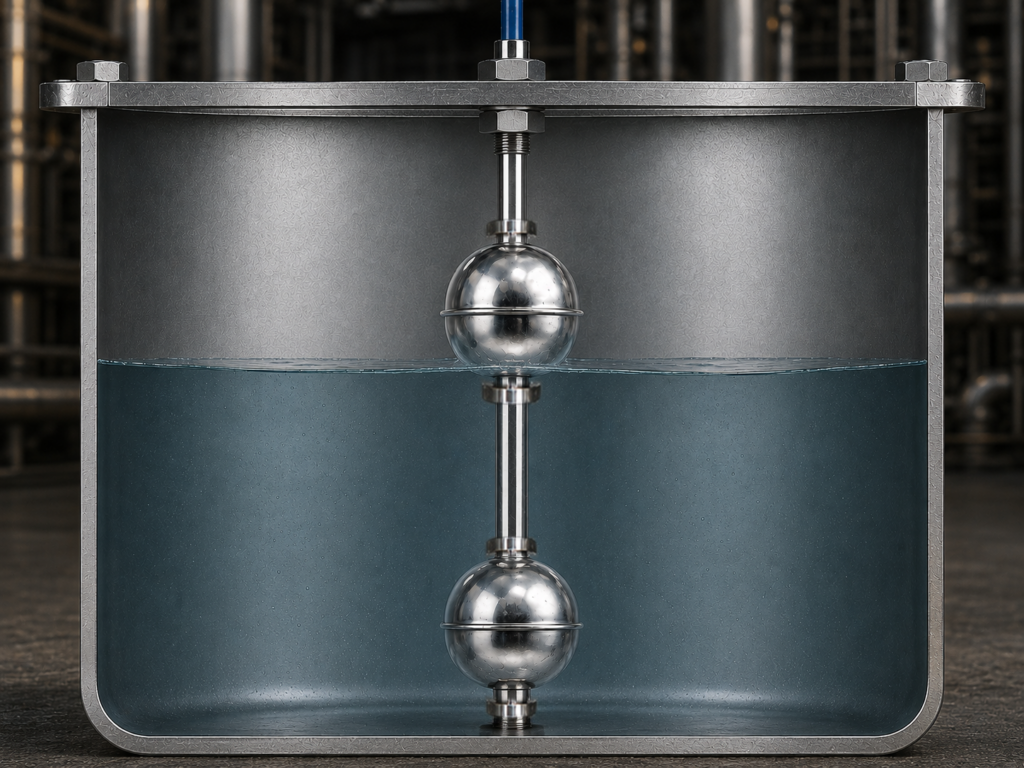
Key advantages of vertical mount switches:
- Multi-point capability: The Whitman L30/L31 Series can accommodate up to six level points on a single shaft, providing discrete feedback for low-low, low, and high level conditions; all through a single tank penetration.
- Adjustable stem lengths: Available in stem lengths up to 72 inches, making them suitable for deep reservoirs, sumps, and large-volume tanks.
- High stability: Top-mounted vertical switches are less susceptible to surface turbulence and sloshing at the tank’s edges, which improves setpoint accuracy.
- Common applications: Hydraulic power unit reservoirs and potable water tanks where interior space allows for a fixed vertical assembly.
What Is a Side-Mount Liquid Level Switch?
Side-mount liquid level switches are installed through the sidewall of a vessel. The float or sensing element actuates as the liquid rises or falls past that specific elevation. These models are ideal for above-ground process tanks where the top must remain clear, or where there is insufficient headroom for a long vertical stem.
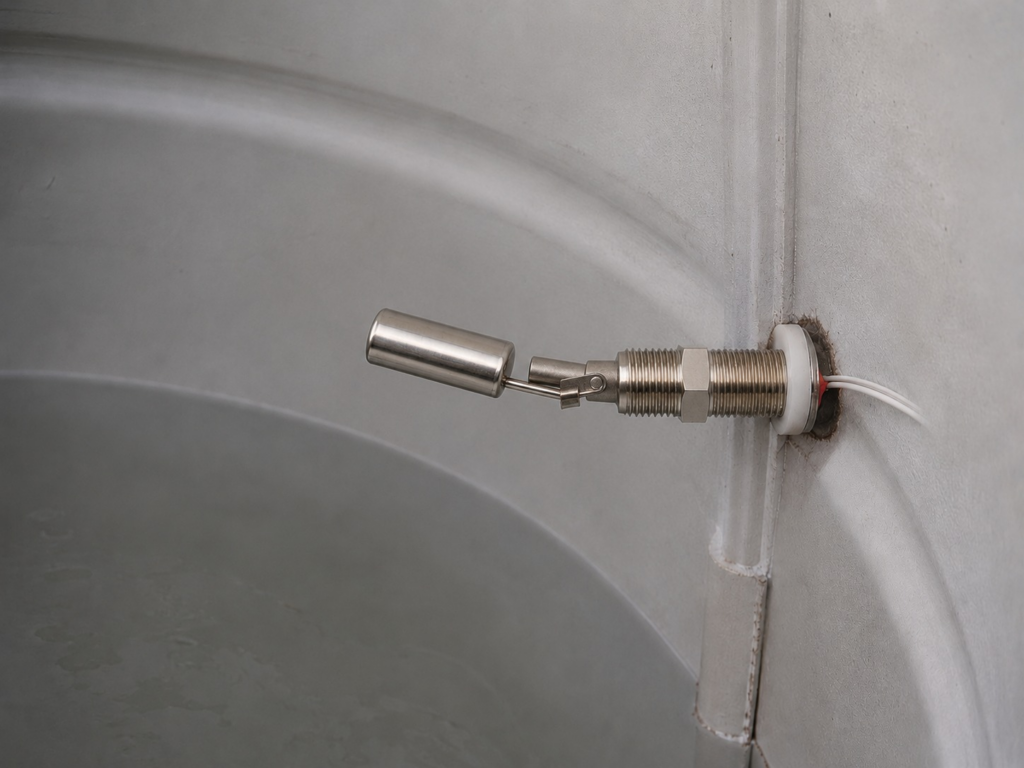
Key advantages of side-mount switches:
- Space efficiency: Compact form factor makes the L20 Series ideal for tight installations, mobile equipment, and skid-mounted systems.
- Easier maintenance: Only the tip of the sensor element contacts the liquid, so maintenance can be performed without disturbing the top of the tank or interrupting operations.
- Simplified control logic: Typically deployed as a single-point high or low level interlock.
- Versatile geometry: The L54/L55 Series features a bent stem design that allows sidewall insertion while providing vertical float actuation for improved sensitivity in confined spaces.
How to Select the Right Liquid Level Switch for Your Application
Choosing between vertical and side-mount configurations requires a systematic review of your process environment and mechanical constraints.
- Tank Geometry
If the top of your tank is obstructed by mixers, heaters, or access hatches, a side-mount switch such as the L20 Polypropylene Series is the practical solution. Conversely, if the sidewalls are insulated or enclosed in secondary containment, a top-entry vertical switch is the logical choice. - Material Compatibility
Ensure that all wetted parts, whether 316 Stainless Steel, Polypropylene, or CPVC are chemically compatible with your specific fluid. This is especially critical when working with crude oil, acids, caustics, or industrial solvents. - Temperature and Pressure Ratings
Vertical switches are generally rated for more demanding environments. For example, the Whitman L60 Series is certified for operating pressures up to 1,000 PSI, making it appropriate for high-pressure hydraulic and industrial applications. - Hygienic and Cleanroom Requirements
In pharmaceutical manufacturing, food processing, or cleanroom environments, side-mount styles are often preferred to minimize fixed objects inside the tank and reduce contamination risk during cleaning cycles. - Number of Control Points Required
If your system needs simultaneous low-low, low, high, and high-high level feedback, a single vertical switch with a multi-point stem is far more cost-effective than installing multiple individual side-mount switches.
About Whitman Controls and Industrial Control Solutions
Whitman Controls, part of Industrial Control Solutions, has been manufacturing precision vacuum, temperature, pressure, and liquid level switches and sensors for over 40 years. What began as a focused instrumentation manufacturer has grown into a trusted name across some of the most demanding industries in the world – aerospace, defense, semiconductor, medical and industrial automation.
As a Service-Disabled Veteran-Owned Small Business, Industrial Control Solutions was built on the same principles that define military service: tireless dedication, rigorous quality standards, and an unwavering commitment to the mission. That foundation isn’t marketing language, it shapes how we engineer every product, handle every order, and support every client relationship.
We don’t offer off-the-shelf compromises. Every sensor solution we build is configurable to your exact application, accounting for media environment, pressure range, temperature exposure, mounting constraints, and dozens of other specifications. If a standard product doesn’t meet your requirements, we build one that does and we back it with full documentation and traceability at every step.
Every product ships with full traceability documentation under our ISO 9001:2015 certification, giving customers confidence that internal processes, materials, and finished products have all met the highest standards of quality and regulatory compliance.
At Industrial Control Solutions, our most loyal clients have been with us for the entirety of our 40+ years in business. That kind of partnership isn’t accidental. It is the direct result of a commitment to delivering exactly what we promise; high-quality products, built to specification, backed by people who stand behind their work.
Our product portfolio spans four specialized USA-manufactured lines:
Whitman Controls – Vacuum, pressure, temperature, and liquid level switches engineered for precision and durability in extreme environments
Load Controls – Pump load controls, compact power sensors, fast-response load controllers, current sensors, and VFD-compatible solutions
Thomas Products – Flow switches, level switches, pump controls, multi-level switches, and visual indicators
Duro-sense – High-quality platinum and noble thermocouples, RTDs, and ISO 17025 calibrated wire
Frequently Asked Questions About Liquid Level Switch Orientation
1. What is the main difference between a vertical and side-mount liquid level switch?
A vertical mount switch is installed through the top or bottom of a tank with the stem submerged into the fluid, making it ideal for multi-point level detection in deep tanks. A side-mount switch is installed through the tank sidewall and is best suited for single-point level indication where the top must remain clear.
2. Can a single vertical liquid level switch monitor multiple level points?
Yes. Vertical switches like the Whitman L30/L31 Series support up to six discrete level points on one sensing shaft, eliminating the need for multiple separate sensors and simplifying wiring and installation.
3. Which liquid level switch is better for chemical or corrosive fluids?
Both vertical and side-mount switches are available with chemically resistant wetted materials including Polypropylene, CPVC, and 316 Stainless Steel. The right choice depends on your specific fluid, Whitman Controls can configure wetted parts to match acids, solvents, and other aggressive media.
4. How do I choose a liquid level switch for a high-pressure application?
For high-pressure environments, vertical switches are typically the better fit. The Whitman L60 Series, for example, is rated up to 1,000 PSI, making it suitable for hydraulic systems and demanding industrial processes where side-mount designs may not be rated high enough.
5. Are side-mount liquid level switches easier to maintain than vertical switches?
Side-mount switches generally allow for easier in-service access because only the sensing tip contacts the liquid and the switch body is mounted on the exterior sidewall. Vertical switches require top-of-tank access, which may involve draining or isolating the tank depending on the installation.