

What Is Specific Gravity and Why Does It Matter for Float Switches?
In liquid level control, specific gravity is one of the most critical factors that determines whether a float switch will work reliably. It is a unitless measurement that compares a liquid’s density to that of water. Since float switches rely on physical fluid displacement to actuate an electrical circuit, the density of the media directly controls the buoyant force acting on the sensor.
At Whitman Controls, our floats are engineered with varied materials and densities to ensure broad compatibility across specific gravity ranges.
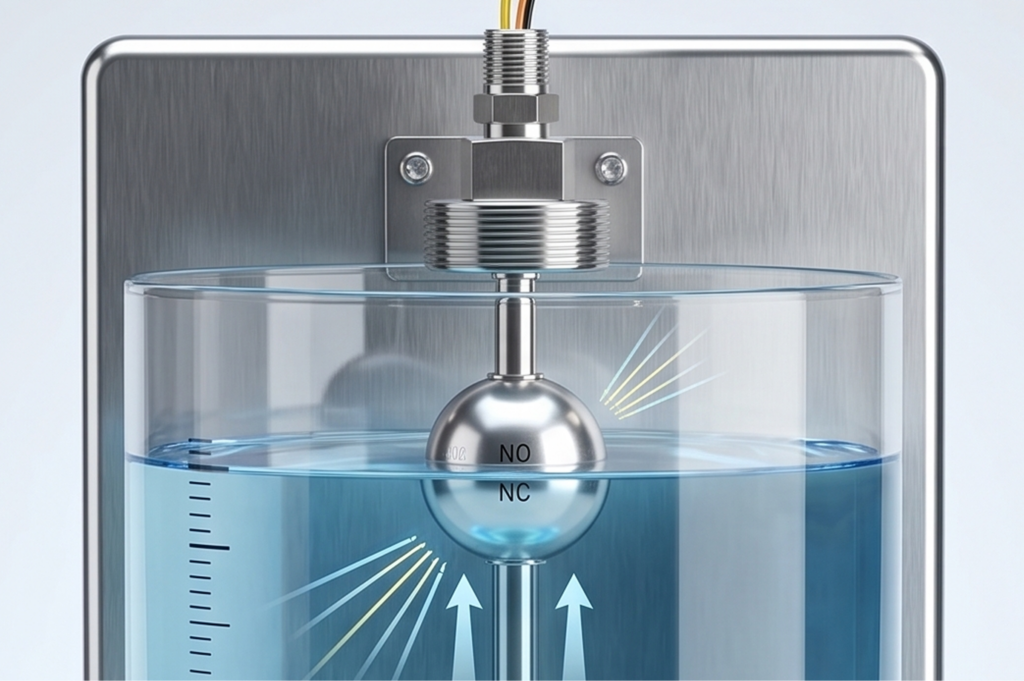
How Buoyancy Works in Float Switch Operation
Buoyancy is the upward force a fluid exerts on any submerged object. The key physics principles every engineer should understand:
- Density dependence: Buoyant force depends on both the weight and shape of the float.
- Water as a baseline: Water has a density of 1,000 kg/m³, defined as a specific gravity of 1.0.
- Floating requirement: For a float to rise and actuate the switch, it must be less dense than the surrounding liquid.
- Temperature effects: Ambient temperature changes can shift switch set points, since specific gravity varies with temperature.
Challenges of Using Float Switches in Low-Density Liquids
Many industrial processes use liquids considerably lighter than water – oils, solvents, and custom chemical blends are common examples. Using a standard water-rated float in a lower-density fluid can cause reaction lag or a complete failure to actuate.
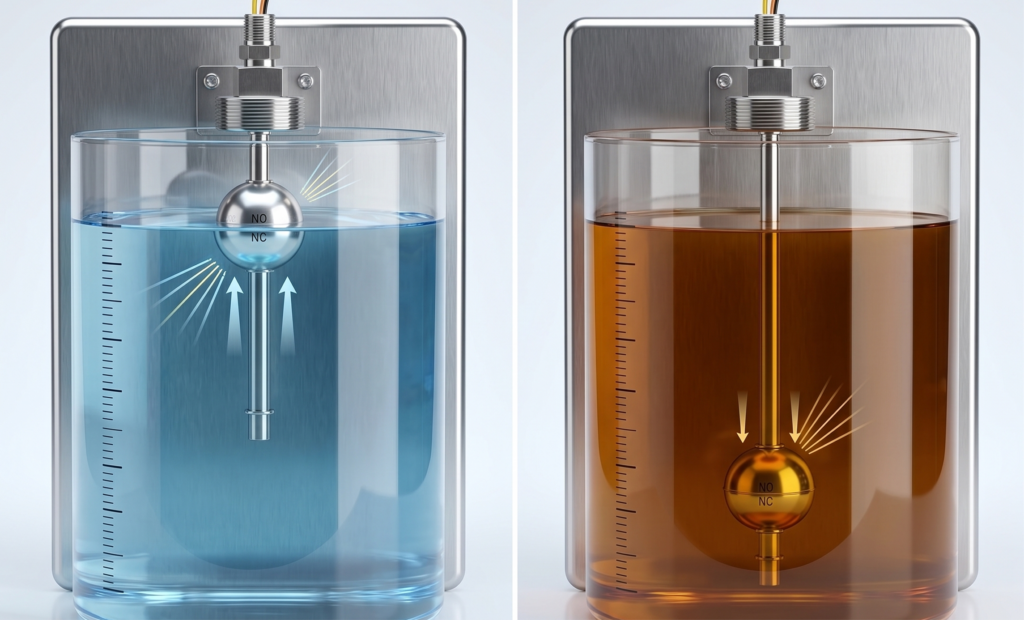
- Light crude oil typically falls between 0.800 and 0.824 specific gravity, significantly lighter than water.
- Level sensors calibrated for water often cannot generate enough buoyant force to overcome the float arm’s mechanical weight in lighter fluids.
- Whitman Controls offers sensors engineered to operate reliably down to a minimum specific gravity of approximately 0.70.
- Polymeric materials like polypropylene outperform heavier stainless steel floats when working with low-density media.
Interface Detection: Measuring the Boundary Between Two Liquids
Some applications require detecting the exact layer where two immiscible liquids meet such as oil floating above water. This boundary is called the liquid interface.

- Interface-calibrated floats are precisely weighted to rest at the boundary between two liquids of differing specific gravities.
- This enables multi-point level switches to deliver discrete feedback signals as each liquid layer rises to the sensor.
- Correct specific gravity calibration prevents common failures such as air entrainment and pump stall-out in hydraulic circuits.
Whitman Controls Product Series for Specific Gravity Applications
Choosing the right float switch starts with matching the product to your fluid’s density and chemical profile. Whitman Controls offers three core series engineered for specific gravity-sensitive applications.
- The L20 Polypropylene Series is built for aggressive chemical environments and lighter fluid densities, with reliable operation down to a minimum specific gravity of 0.74. Its polypropylene construction resists chemical attack while keeping the float lightweight enough to actuate in low-density media.
- The L30 Multi-Level Series is a custom-configurable solution designed for hydraulic oils and other specialty fluids, rated down to a minimum specific gravity of 0.70; making it one of the most capable options for light industrial fluids. Its multi-point design allows tailored level detection across a range of fluid conditions.
- The L95 Hydrostatic Series takes a different approach entirely. Rather than relying on buoyancy, it measures the weight of the fluid column above the sensor to derive level, a method that is also directly influenced by liquid density, making proper specific gravity input essential for accurate readings.
About Whitman Controls and Industrial Control Solutions
Whitman Controls, part of Industrial Control Solutions, has been manufacturing precision vacuum, temperature, pressure, and liquid level switches and sensors for over 40 years. What began as a focused instrumentation manufacturer has grown into a trusted name across some of the most demanding industries in the world – aerospace, defense, semiconductor, medical and industrial automation.
As a Service-Disabled Veteran-Owned Small Business, Industrial Control Solutions was built on the same principles that define military service: tireless dedication, rigorous quality standards, and an unwavering commitment to the mission. That foundation isn’t marketing language, it shapes how we engineer every product, handle every order, and support every client relationship.
We don’t offer off-the-shelf compromises. Every sensor solution we build is configurable to your exact application, accounting for media environment, pressure range, temperature exposure, mounting constraints, and dozens of other specifications. If a standard product doesn’t meet your requirements, we build one that does and we back it with full documentation and traceability at every step.
Every product ships with full traceability documentation under our ISO 9001:2015 certification, giving customers confidence that internal processes, materials, and finished products have all met the highest standards of quality and regulatory compliance.
At Industrial Control Solutions, our most loyal clients have been with us for the entirety of our 40+ years in business. That kind of partnership isn’t accidental. It is the direct result of a commitment to delivering exactly what we promise; high-quality products, built to specification, backed by people who stand behind their work.
Our product portfolio spans four specialized USA-manufactured lines:
Whitman Controls – Vacuum, pressure, temperature, and liquid level switches engineered for precision and durability in extreme environments
Load Controls – Pump load controls, compact power sensors, fast-response load controllers, current sensors, and VFD-compatible solutions
Thomas Products – Flow switches, level switches, pump controls, multi-level switches, and visual indicators
Duro-sense – High-quality platinum and noble thermocouples, RTDs, and ISO 17025 calibrated wire
Frequently Asked Questions
1. What specific gravity is required for a float switch to work?
The float must be less dense than the surrounding liquid to rise and actuate. Most standard switches are calibrated for water at SG 1.0, but Whitman Controls sensors can operate reliably down to SG 0.70 depending on the series.
2. Can a float switch work in oil or light chemicals?
Yes, but the switch must be specifically rated for low-density media. Standard water-rated floats often fail to actuate in lighter fluids due to insufficient buoyant force. The L20 and L30 series are engineered for exactly these conditions.
3. What happens if I use the wrong float switch for my fluid?
The float may not rise fully, leading to missed level signals, reaction lag, or complete switch failure. In hydraulic systems, this can also cause pump stall-out, making correct specific gravity matching critical.
4. What is a liquid interface float switch used for?
It detects the boundary between two immiscible liquids, such as oil sitting above water. The float is precisely weighted to rest at that interface, allowing independent level detection of each liquid layer.
5. Does temperature affect float switch performance?
Yes. Liquid specific gravity changes with temperature, which can shift switch set points over time. It is important to account for your full operating temperature range when selecting and calibrating a sensor.