
In industrial instrumentation, the term “hysteresis” is often discussed alongside reliability and precision. Hysteresis describes the physical difference in how a pressure or vacuum switch responds to increasing pressure versus decreasing pressure. Understanding this concept is vital for engineers who need to maintain stable system operations and avoid the mechanical fatigue that comes with improper sensor selection. At Whitman Controls, we meticulously design our sensors to manage hysteresis, ensuring consistent performance even in severe environments.
What Is Hysteresis in Pressure Sensing?
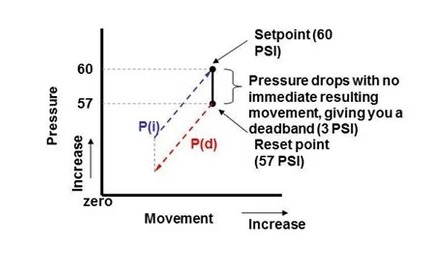
Hysteresis is essentially the lag between the switch’s actuation point (set point) and its reset point. It is often referred to as the “differential” or “deadband,” representing the mechanical motion lost within the electrical switch element while it reverses itself.
- Mechanical Motion Loss: Hysteresis occurs because the internal sensing element requires a specific amount of force to change states, and that force must dissipate significantly before the element can return to its original position.
- Amperage Influence: Generally, the differential or hysteresis is greater in high-amperage switches than in low-amperage switches.
- Measurement: It is typically defined as the difference between increasing and decreasing readings when the switch operates between the set point and reset point.
- Predictable Performance: While some level of hysteresis is inherent in all mechanical switches, high-quality models like the Whitman P100G provide highly accurate set points and low repeatability, making the hysteresis effect predictable and manageable.
How Does Hysteresis Affect Industrial System Performance?
Hysteresis is not necessarily a “flaw”; in fact, it is often a desired feature in industrial automation. Without it, many processes would suffer from “chatter,” a rapid and destructive toggling of the electrical circuit.
- Preventing Over-Cycling: In applications like pump and fan control, a wide differential is often ideal to prevent the system from turning on and off too frequently, which extends the life of the motor.
- Ensuring Stability: For central plant utilities, such as chilled water recirculation or hot water expansion tanks, consistent temperature and moderate-density liquids require switches that can handle slight pressure drifts without triggering false alarms.
- Operational Integrity: In high-pressure testing, such as mining equipment hydraulic test rigs, the switch must remain reliable for set point accuracy even after experiencing significant pressure spikes that could otherwise shift the reset point.
- Repeatability: Highly repeatable switches, like the Whitman J705G, ensure that the hysteresis range remains narrow and consistent, which is critical for safety abort processes in automated rigs.

How to Choose the Right Hysteresis Level for Your Application
Choosing the right level of hysteresis requires a deep understanding of your specific application and media environment. Whitman Controls offers various set point options, including factory-preset (F-set) non-adjustable models and customer-set (C-set) field-adjustable versions, to help you lock in the precise performance you need.
- Custom Set Points: Many Whitman models, such as the P117, W117, and J205 series, are readily adjustable throughout their prescribed range by loosening a knurled locking ring to fine-tune the actuation point.
- Severe Duty Applications: For hydraulic systems prone to massive spikes, piston-actuated switches like the J705 can withstand spikes up to 9,000 PSIG without compromising the integrity of the set point or the internal differential.
- Hygienic Requirements: In semiconductor or medical applications, our Ultra Pure line ensures that the mechanical components responsible for switching remain free of detectable impurities that could interfere with consistent actuation.
About Whitman Controls and Industrial Control Solutions
Whitman Controls, part of Industrial Control Solutions, has been manufacturing precision vacuum, temperature, pressure, and liquid level switches and sensors for over 40 years. What began as a focused instrumentation manufacturer has grown into a trusted name across some of the most demanding industries in the world – aerospace, defense, semiconductor, medical and industrial automation.
As a Service-Disabled Veteran-Owned Small Business, Industrial Control Solutions was built on the same principles that define military service: tireless dedication, rigorous quality standards, and an unwavering commitment to the mission. That foundation isn’t marketing language, it shapes how we engineer every product, handle every order, and support every client relationship.
We don’t offer off-the-shelf compromises. Every sensor solution we build is configurable to your exact application, accounting for media environment, pressure range, temperature exposure, mounting constraints, and dozens of other specifications. If a standard product doesn’t meet your requirements, we build one that does and we back it with full documentation and traceability at every step.
Every product ships with full traceability documentation under our ISO 9001:2015 certification, giving customers confidence that internal processes, materials, and finished products have all met the highest standards of quality and regulatory compliance.
At Industrial Control Solutions, our most loyal clients have been with us for the entirety of our 40+ years in business. That kind of partnership isn’t accidental. It is the direct result of a commitment to delivering exactly what we promise; high-quality products, built to specification, backed by people who stand behind their work.
Our product portfolio spans four specialized USA-manufactured lines:
Whitman Controls – Vacuum, pressure, temperature, and liquid level switches engineered for precision and durability in extreme environments
Load Controls – Pump load controls, compact power sensors, fast-response load controllers, current sensors, and VFD-compatible solutions
Thomas Products – Flow switches, level switches, pump controls, multi-level switches, and visual indicators
Duro-sense – High-quality platinum and noble thermocouples, RTDs, and ISO 17025 calibrated wire
Frequently Asked Questions
Q. What is the difference between set point and reset point in a pressure switch?
The set point is the pressure at which the switch activates or trips. The reset point is the pressure at which it returns to its original state. The difference between the two is the hysteresis or deadband.
Q: Is hysteresis the same as deadband?
Yes. In pressure switch terminology, hysteresis, deadband, and differential are often used interchangeably to describe the gap between the actuation and reset pressures.
Q: Does higher amperage increase hysteresis?
Generally, yes. High-amperage switches tend to exhibit a greater differential than low-amperage switches due to the increased force required to change states within the switch element.
Q: What happens if a pressure switch has too little hysteresis?
A switch with too little hysteresis is prone to chatter rapid, repeated toggling of the circuit around the set point which causes mechanical wear, electrical arcing, and premature failure of both the switch and connected equipment.