
What Makes Sensing Element Selection So Critical?
Selecting a pressure switch goes well beyond identifying a set point. The internal sensing element, the component that physically responds to pressure changes, determines how durable, sensitive, and long-lasting the switch will be in real operating conditions.
At Whitman Controls, the sensing element choice is treated as a core engineering decision, not an afterthought. This guide breaks down three primary sensing technologies – diaphragm, piston, and capsule, to help engineers and procurement teams make confident, application-specific choices.
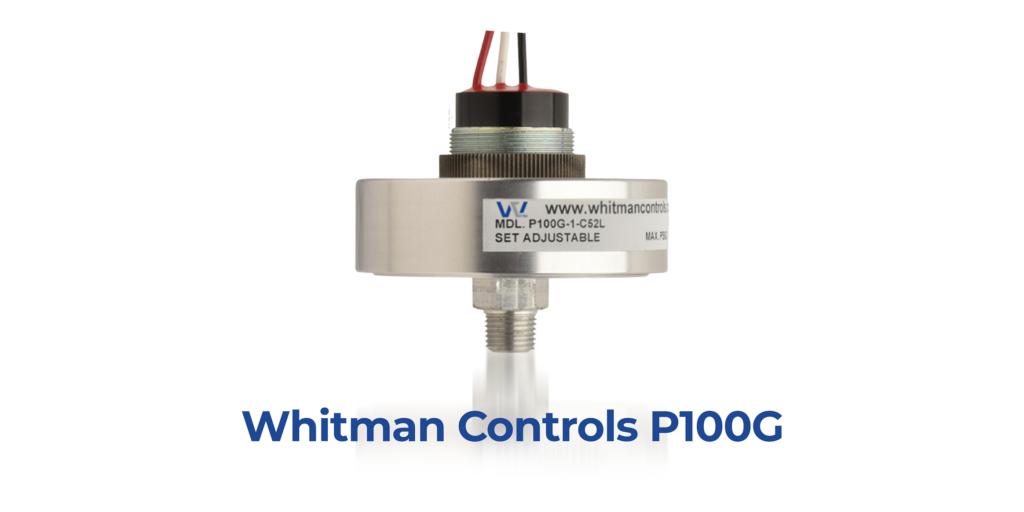
Diaphragm Pressure Switches – Best for Sensitivity and Low-Pressure Precision
Diaphragm sensing elements use a flexible membrane that deflects under pressure. Because the membrane’s surface area is relatively large, it can detect minute changes in pressure or vacuum that other sensor types tend to miss.
This makes diaphragm switches the preferred choice for applications where precision at lower set points matters most.
Where diaphragm switches excel:
- High sensitivity at low pressures – Ideal for forced draft blowers and natural gas wellheads where accuracy at light pressures is essential.
- Vacuum monitoring – Models like the Whitman P117V are engineered to handle vacuum ranges from 1.6 to 28.2 InHg reliably.
- Corrosive media compatibility – Wetted materials including Buna N, Viton, and 316 Stainless Steel allow for safe use with aggressive fluids.
Where diaphragm switches have limits:
Diaphragm designs carry lower maximum system pressure ratings compared to piston types. They are also more vulnerable to damage from sudden, extreme pressure spikes; an important consideration in high-cycling or surge-prone systems.
Whitman Controls models in this category: P100G series, P88G series, P117V
Piston Pressure Switches – Built for High-Pressure and Severe-Duty Environments
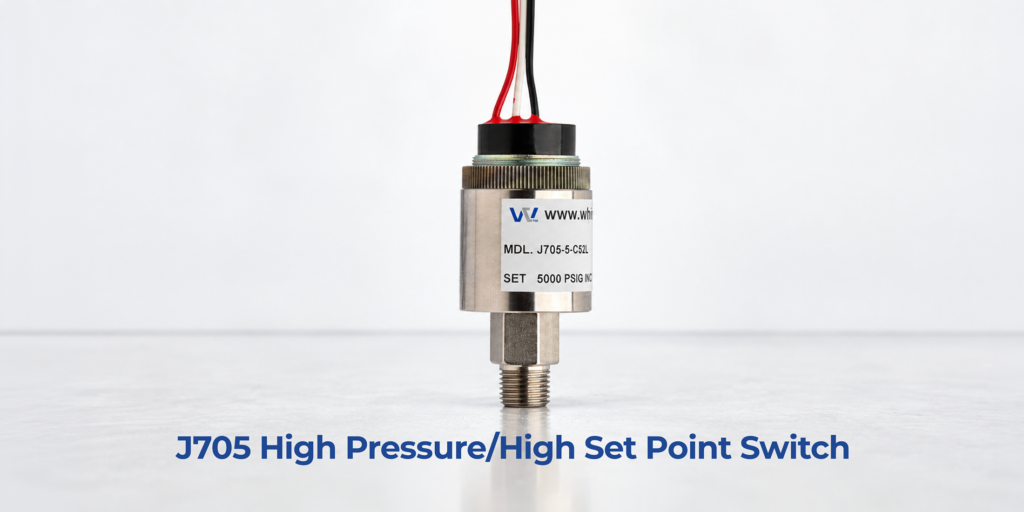
Piston-actuated switches operate on a straightforward mechanical principle: a piston is pushed against a calibrated spring. Once system pressure overcomes the spring force, the switch cycles. This simple, robust mechanism makes piston switches exceptionally well-suited to demanding industrial environments.
Where piston switches excel:
- Extreme pressure resilience – Engineered to handle pressure spikes up to 9,000 PSIG without compromising switch integrity.
- High-pressure system ranges – Appropriate for systems operating between 500 and 6,000 PSIG, including hydraulic test rigs and mining equipment.
- Long service life in high-cycling environments – Piston designs maintain stability even after repeated cycles under rugged conditions.
- Compatibility with dirty fluids – Models like the J705 work reliably with dirty hydraulic fluids, oils, and various industrial gases
Whitman Controls models in this category: J705 series, P605 series
Capsule and Compound Pressure Switches – Specialized Solutions for Niche Applications
While bellows represent an older sensing approach, Whitman Controls has moved toward advanced capsule and compound designs that deliver superior performance in specialized environments. These switches offer a compact footprint, broad set point range, and exceptional durability.
Where capsule and compound switches stand out:
- Ultra-high purity environments – The W117 series uses an electron beam welded capsule construction, making it appropriate for silicon wafer ovens and medical device manufacturing where contamination cannot be tolerated.
- Compound pressure and vacuum systems – The P100C handles systems that swing between positive pressure and vacuum, providing accurate set points and low repeatability error in both directions.
- Space-constrained installations – Miniature capsule designs fit into tight spaces where a standard diaphragm or piston housing simply will not.
Whitman Controls models in this category: P117 Stainless Steel series, W117 series, P100C
How to Select the Right Pressure Switch for Your Application
Choosing between diaphragm, piston, and capsule switches requires a structured review of four core variables. Work through these in order:
Step 1 – Determine Maximum System Pressure: Account for normal operating pressure and potential surge or spike pressures. This will immediately eliminate sensing technologies that cannot handle the load.
Step 2 – Define Your Required Set Point: Identify the exact pressure at which you need the switch to trigger, and whether activation should occur on increasing or decreasing pressure.
Step 3 – Confirm Media Compatibility: Match the wetted materials such as 316 Stainless Steel, Buna N, or Viton O-rings to the fluid, gas, or chemical your system carries. Incompatible materials will degrade switch performance and reduce service life.
Step 4 – Decide on Adjustability: Choose between a factory-set (F-set) non-adjustable model for fixed, repeatable set points or a customer-set (C-set) field-adjustable model for applications where conditions may evolve over time.
About Whitman Controls and Industrial Control Solutions
Whitman Controls, part of Industrial Control Solutions, has been manufacturing precision vacuum, temperature, pressure, and liquid level switches and sensors for over 40 years. What began as a focused instrumentation manufacturer has grown into a trusted name across some of the most demanding industries in the world – aerospace, defense, semiconductor, medical and industrial automation.
As a Service-Disabled Veteran-Owned Small Business, Industrial Control Solutions was built on the same principles that define military service: tireless dedication, rigorous quality standards, and an unwavering commitment to the mission. That foundation isn’t marketing language, it shapes how we engineer every product, handle every order, and support every client relationship.
We don’t offer off-the-shelf compromises. Every sensor solution we build is configurable to your exact application, accounting for media environment, pressure range, temperature exposure, mounting constraints, and dozens of other specifications. If a standard product doesn’t meet your requirements, we build one that does and we back it with full documentation and traceability at every step.
Every product ships with full traceability documentation under our ISO 9001:2015 certification, giving customers confidence that internal processes, materials, and finished products have all met the highest standards of quality and regulatory compliance.
At Industrial Control Solutions, our most loyal clients have been with us for the entirety of our 40+ years in business. That kind of partnership isn’t accidental. It is the direct result of a commitment to delivering exactly what we promise; high-quality products, built to specification, backed by people who stand behind their work.
Our product portfolio spans four specialized USA-manufactured lines:
Whitman Controls – Vacuum, pressure, temperature, and liquid level switches engineered for precision and durability in extreme environments
Load Controls – Pump load controls, compact power sensors, fast-response load controllers, current sensors, and VFD-compatible solutions
Thomas Products – Flow switches, level switches, pump controls, multi-level switches, and visual indicators
Duro-sense – High-quality platinum and noble thermocouples, RTDs, and ISO 17025 calibrated wire
Frequently Asked Questions
Q1: Can a diaphragm pressure switch handle vacuum applications? Yes. Diaphragm switches like the Whitman P117V are specifically designed for vacuum monitoring and can handle ranges from 1.6 to 28.2 InHg. Their large membrane surface area makes them well-suited for detecting small negative pressure changes.
Q2: What is the maximum pressure a piston pressure switch can tolerate? Whitman Controls piston switches, including the J705 series, are built to withstand pressure spikes up to 9,000 PSIG. For continuous operating ranges, piston switches are appropriate for systems between 500 and 6,000 PSIG.
Q3: What does “wetted material” mean, and why does it matter? Wetted materials are the internal components of the switch that come into direct contact with the process media, typically the sensing element and any seals or O-rings. Choosing compatible materials (such as 316 Stainless Steel for corrosive fluids or Buna N for standard hydraulic oil) prevents premature degradation and ensures long-term switch performance.
Q4: What is the difference between an F-set and a C-set pressure switch? An F-set (factory-set) switch has its set point calibrated at the factory and is not adjustable in the field. A C-set (customer-set) switch allows the user to adjust the set point after installation. F-set models are preferred for fixed, repeatable processes; C-set models offer flexibility for variable or evolving operating conditions.
Q5: Are Whitman Controls pressure switches compatible with dirty hydraulic fluids? Yes. Piston models such as the J705G are rated for use with dirty hydraulic fluids, oils, and various gases, making them appropriate for applications like construction equipment, mining machinery, and industrial test rigs.