
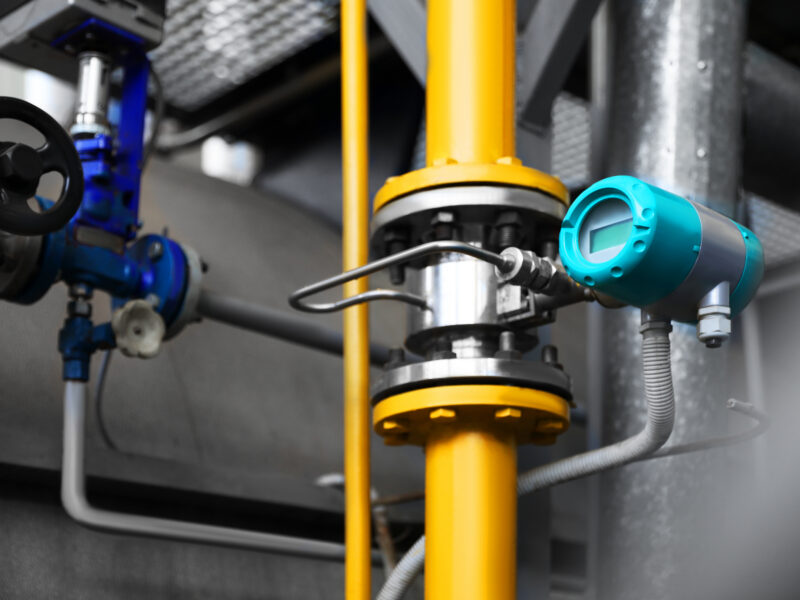
What Is a Vibrating Fork Level Switch?
A vibrating fork level switch is a high-performance point level sensor designed to detect the presence or absence of media using resonance technology. Unlike traditional float switches that rely on buoyancy, these devices use electronically stimulated tines that vibrate at a specific natural frequency. When the medium, whether liquid or solid covers the tines, the vibration frequency shifts, triggering an electronic signal to indicate that a level has been reached.
This makes vibrating fork level switches one of the most reliable and maintenance-free solutions for point-level detection across industrial environments.
How Does a Vibrating Fork Level Switch Work?
The operating principle is rooted in the physics of resonance. An internal piezoelectric crystal drives the fork tines to vibrate at their natural resonance frequency in free air. When the tines contact a medium, three things happen in sequence.
- Frequency Shift: When the tines are submerged in liquid or covered by powders and granules, the vibration frequency drops relative to its natural free-air state.
- Switching Response: This shift is immediately detected by the internal electronics, providing a fast switching response to the connected control system.
- Versatile Mounting: These compact yet durable devices can be mounted on the top or side of tanks and silos, functioning as high-level or low-level indicators depending on the installation requirement.
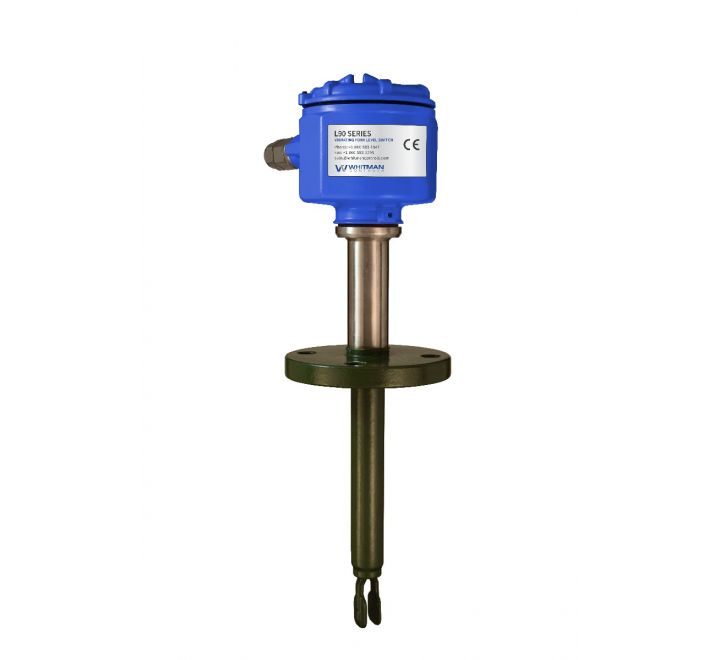
- Rugged Materials: Whitman models such as the L90 series feature 316/316L stainless steel wetted parts, with optional coatings such as PTFE or Halar for use with aggressive media.
Vibrating Fork Level Switches for Solids: Powders and Granules
While many vibrating fork level switches are optimized for liquids, specialized models like the Whitman L92 series are engineered specifically to detect solids and powders. Handling bulk solids requires sensors capable of overcoming the unique physical challenges of granular materials, such as varying bulk densities and potential material buildup on sensing surfaces.
- Density Compensation: Solids-optimized models are designed to work across a range of minimum bulk densities depending on fork length.
- Anti-Buildup Design: The fork geometry is ideally suited to free-flowing powders and granules materials commonly handled in agriculture, cement manufacturing, and similar industries.
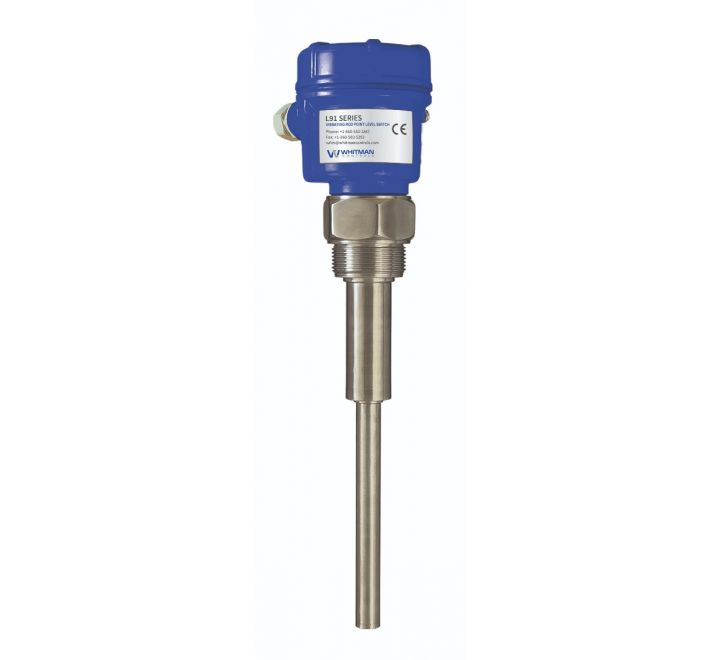
- Rod Alternatives: For certain solid applications, a vibrating rod such as the L91 series may be preferred over a fork, reducing the risk of material becoming wedged between tines.
- Custom Insertion Lengths: Sensors for solid media often require specific insertion lengths. Customizable options are available from 125 mm to 3,000 mm, enabling reach into deep silos or grain elevators.
Key Features for Demanding Industrial Environments
Vibrating fork level switches are frequently selected for severe-duty applications where temperature stability, pressure tolerance, and environmental protection are essential for long-term process control.
- Extreme Temperature Range: Depending on the model, these sensors can operate across process temperatures from −22°F to +482°F (−30°C to +250°C).
- High-Pressure Capability: Units are built to withstand demanding pressure environments, with maximum ratings reaching up to 218 PSI.
- Ingress Protection: Models typically carry IP66 to IP68 ratings, confirming weatherproof construction and suitability for washdown environments.
- Explosion-Proof Options: Many vibrating fork level switches are available in flameproof or explosion-proof enclosures, making them suitable for use in classified hazardous areas.
About Whitman Controls and Industrial Control Solutions
Whitman Controls, part of Industrial Control Solutions, has been manufacturing precision vacuum, temperature, pressure, and liquid level switches and sensors for over 40 years. What began as a focused instrumentation manufacturer has grown into a trusted name across some of the most demanding industries in the world – aerospace, defense, semiconductor, medical and industrial automation.
As a Service-Disabled Veteran-Owned Small Business, Industrial Control Solutions was built on the same principles that define military service: tireless dedication, rigorous quality standards, and an unwavering commitment to the mission. That foundation isn’t marketing language, it shapes how we engineer every product, handle every order, and support every client relationship.
We don’t offer off-the-shelf compromises. Every sensor solution we build is configurable to your exact application, accounting for media environment, pressure range, temperature exposure, mounting constraints, and dozens of other specifications. If a standard product doesn’t meet your requirements, we build one that does and we back it with full documentation and traceability at every step.
Every product ships with full traceability documentation under our ISO 9001:2015 certification, giving customers confidence that internal processes, materials, and finished products have all met the highest standards of quality and regulatory compliance.
At Industrial Control Solutions, our most loyal clients have been with us for the entirety of our 40+ years in business. That kind of partnership isn’t accidental. It is the direct result of a commitment to delivering exactly what we promise; high-quality products, built to specification, backed by people who stand behind their work.
Our product portfolio spans four specialized USA-manufactured lines:
Whitman Controls – Vacuum, pressure, temperature, and liquid level switches engineered for precision and durability in extreme environments
Load Controls – Pump load controls, compact power sensors, fast-response load controllers, current sensors, and VFD-compatible solutions
Thomas Products – Flow switches, level switches, pump controls, multi-level switches, and visual indicators
Duro-sense – High-quality platinum and noble thermocouples, RTDs, and ISO 17025 calibrated wire
Frequently Asked Questions
Q1: What is a vibrating fork level switch used for?
A vibrating fork level switch is a point-level sensor used to detect whether a material liquid, powder, or granule has reached a specific level inside a tank, silo, or vessel. It triggers a switching signal to alert or control a connected system when the set level is reached or dropped below.
Q2: How does a vibrating fork level switch detect level?
The sensor uses a piezoelectric crystal to vibrate fork tines at a natural resonance frequency in free air. When the tines contact a medium, the frequency decreases. The internal electronics detect this shift and trigger an output signal to the control system.
Q3: Can vibrating fork level switches be used for solids and powders?
Yes. Specialized models such as the Whitman L92 series are engineered for solid media detection, including free-flowing powders and granules. These are designed to handle varying bulk densities and minimize material buildup on the sensing tines.
Q4: What is the difference between a vibrating fork and a vibrating rod level switch?
A vibrating fork uses two tines that can be prone to material bridging in some granular applications. A vibrating rod, such as the Whitman L91, uses a single sensing element, reducing the risk of material becoming trapped between tines, making it preferable for certain bulk solids.
Q5: What temperatures and pressures can vibrating fork level switches handle?
Depending on the model, vibrating fork level switches can operate across process temperatures from −22°F to +482°F and pressure conditions up to 218 PSI.