

What Is a Field-Adjustable Pressure Switch?
A field-adjustable pressure switch lets you set or fine-tune actuation parameters directly on-site, without sending the unit back to the factory. This is especially valuable when dealing with variables like geographical elevation, ambient temperature swings, or changing media properties that affect system behavior after installation.
At Whitman Controls, we manufacture several styles of adjustable switches engineered for ease of use and long-term stability across diverse operating environments.
Understanding Set Point Configuration Types
Before making any adjustments, identify which set point configuration your unit uses, this determines whether, and how, it can be modified.
- C-Set (Customer Set): Shipped from the factory ready for the customer to configure in the field.
- K-Set (Factory Pre-Set): Pre-set at the factory to an initial specification, but remains field-adjustable for fine-tuning on-site.
- F-Set (Factory Set): Pre-set and sealed at the factory. These cannot be readjusted in the field.
How to Adjust the Set Point by Model Series
The physical adjustment method varies by model. Each series uses a locking mechanism designed to prevent accidental shifts from vibration or pressure spikes.
- Jam Nut and Adjusting Ring Models (P100, P117, W117, P119, J205, J705)
- Loosen the knurled locking ring.
- To lower the set point: turn the electrical switch clockwise.
- To raise the set point: turn it counterclockwise.
- Once you reach the desired setting, hand-tighten the ring or apply slight pressure with pliers to lock it in place.
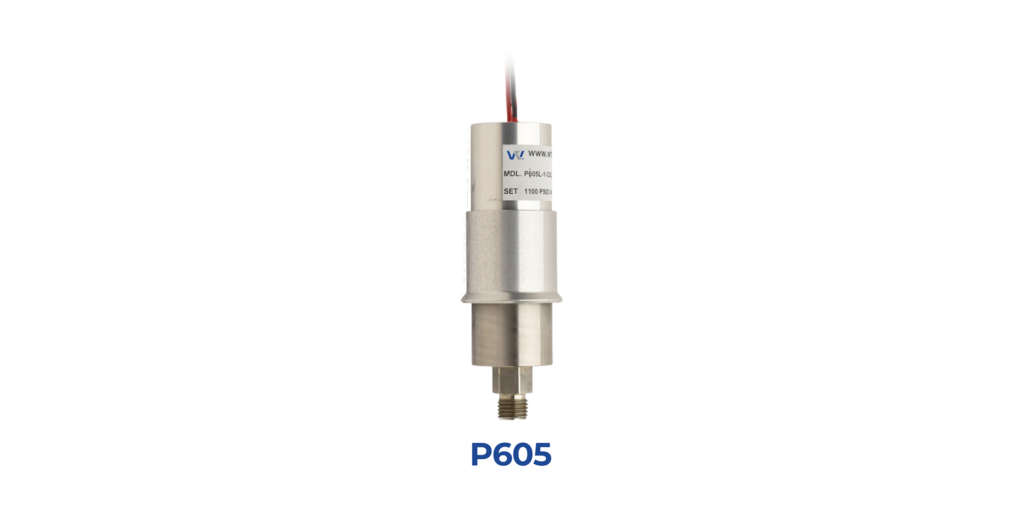
- P605 Series (Severe-Duty Switches)
These switches require a specialized adjustment pin.- Slide the spring clip cover downward.
- Insert a 0.093-inch diameter pin into the adjusting ring hole.
- Push the pin right (counterclockwise) to lower the set point.
- Push the pin left (clockwise) to raise the set point.
- Vacuum Switch Models
Rotation direction for vacuum switches is reversed compared to standard pressure models:- To lower the vacuum set point: turn counterclockwise.
- To raise the vacuum set point: turn clockwise.
Best Practices for Field Calibration
Accurate calibration depends on more than just turning the right ring. Follow these practices to reduce repeatability errors and ensure stable performance.
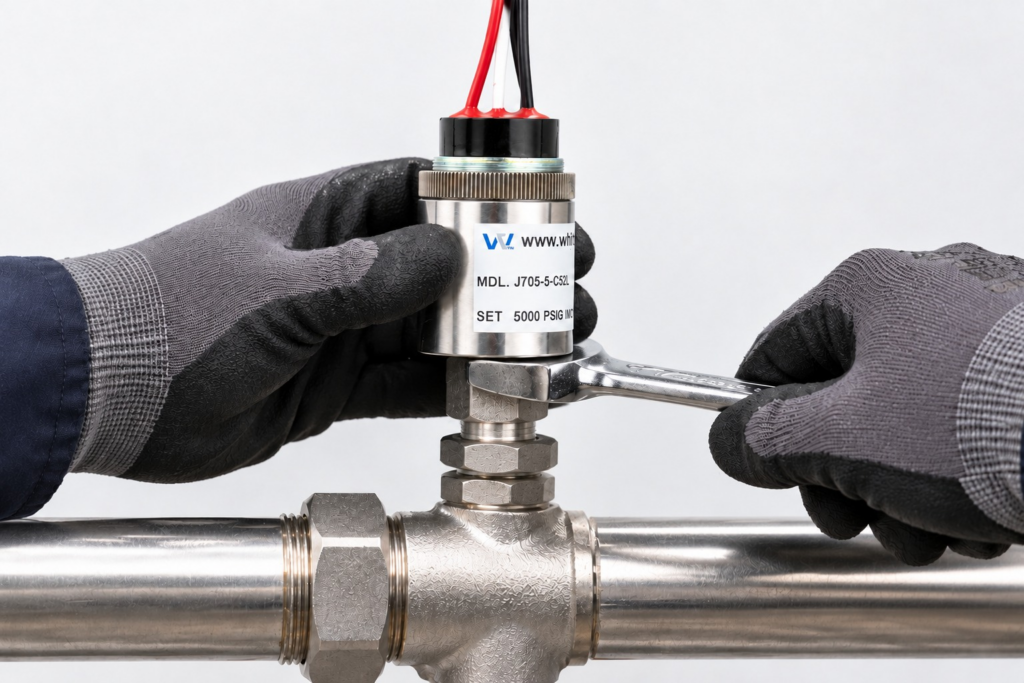
- Hold the switch body steady. When using tools, place a wrench on the fitting hex to stabilize the switch body while gripping the knurled ring separately with pliers. Applying torque to the body itself can damage the fitting.
- Verify actuation after adjustment. Cycle the system pressure or vacuum to confirm the switch actuates at the newly set point before returning the system to full operation.
- Account for temperature effects. Ambient temperature changes can shift switch set points because the specific gravity of liquids varies with temperature. Calibrate under conditions that reflect actual operating temperatures where possible.
- Use redundant sensors in safety-critical systems. In applications like medical X-ray equipment, a single point of failure is unacceptable. Redundant sensors provide a protective hedge when the consequences of a missed actuation are severe.
About Whitman Controls and Industrial Control Solutions
Whitman Controls, part of Industrial Control Solutions, has been manufacturing precision vacuum, temperature, pressure, and liquid level switches and sensors for over 40 years. What began as a focused instrumentation manufacturer has grown into a trusted name across some of the most demanding industries in the world – aerospace, defense, semiconductor, medical and industrial automation.
As a Service-Disabled Veteran-Owned Small Business, Industrial Control Solutions was built on the same principles that define military service: tireless dedication, rigorous quality standards, and an unwavering commitment to the mission. That foundation isn’t marketing language, it shapes how we engineer every product, handle every order, and support every client relationship.
We don’t offer off-the-shelf compromises. Every sensor solution we build is configurable to your exact application, accounting for media environment, pressure range, temperature exposure, mounting constraints, and dozens of other specifications. If a standard product doesn’t meet your requirements, we build one that does and we back it with full documentation and traceability at every step.
Every product ships with full traceability documentation under our ISO 9001:2015 certification, giving customers confidence that internal processes, materials, and finished products have all met the highest standards of quality and regulatory compliance.
At Industrial Control Solutions, our most loyal clients have been with us for the entirety of our 40+ years in business. That kind of partnership isn’t accidental. It is the direct result of a commitment to delivering exactly what we promise; high-quality products, built to specification, backed by people who stand behind their work.
Our product portfolio spans four specialized USA-manufactured lines:
Whitman Controls – Vacuum, pressure, temperature, and liquid level switches engineered for precision and durability in extreme environments
Load Controls – Pump load controls, compact power sensors, fast-response load controllers, current sensors, and VFD-compatible solutions
Thomas Products – Flow switches, level switches, pump controls, multi-level switches, and visual indicators
Duro-sense – High-quality platinum and noble thermocouples, RTDs, and ISO 17025 calibrated wire
Frequently Asked Questions
Q1: What is the difference between deadband and hysteresis in a pressure switch?
They refer to the same underlying behavior but from different perspectives. Deadband specifically describes the pressure gap between the actuation point and the reset point. Hysteresis is the broader engineering term for this lag in switch response when transitioning between increasing and decreasing pressure states. In practice, both terms are used interchangeably in pressure switch documentation.
Q2: What causes switching chatter in pressure switches?
Switching chatter occurs when a pressure switch has an insufficient deadband relative to the natural fluctuations in system pressure. The switch repeatedly triggers and resets in rapid succession, accelerating wear on the switch contacts, motor starters, solenoids, or other controlled equipment. Selecting a switch with an appropriately wider differential for your system eliminates this issue.
Q3: Is a larger deadband always better for my system?
Not necessarily. A wider deadband prevents over-cycling but allows the process variable to deviate further from the set point before the switch resets. For applications requiring tight process control such as precision hydraulic systems – a narrower, calibrated deadband is preferable. The right deadband depends on your tolerance for pressure variation versus mechanical longevity.
Q4: Can the deadband on a pressure switch be adjusted?
Some pressure switch models offer adjustable differential ranges, while others are factory-calibrated to fixed reset points. Whitman Controls offers both standard and calibrated switch options, depending on how precisely your system needs to operate.
Q5: What pressure switch should I use for high-spike environments like mining or hydraulic test rigs?
The Whitman Controls P605 Series is engineered for exactly these conditions. It can withstand pressure spikes up to 9,000 PSIG without causing the set point or reset point to shift, maintaining consistent internal differential settings even under severe mechanical stress.