

Material Selection Is a Patient Safety Decision
In pharmaceutical manufacturing and medical device production, process instrumentation is not just equipment, it is a direct variable in product safety. From sterile injectables to “sample-to-answer” diagnostic test kits, even trace contamination from a sensor’s wetted surface can compromise an entire batch or, more critically, harm a patient.
This is why the two most trusted material standards in pharmaceutical sensing are 316L stainless steel and USP Class VI-rated polymers and why serious pharma OEMs do not accept substitutes.
316L Stainless Steel: Built for Hygienic Process Environments
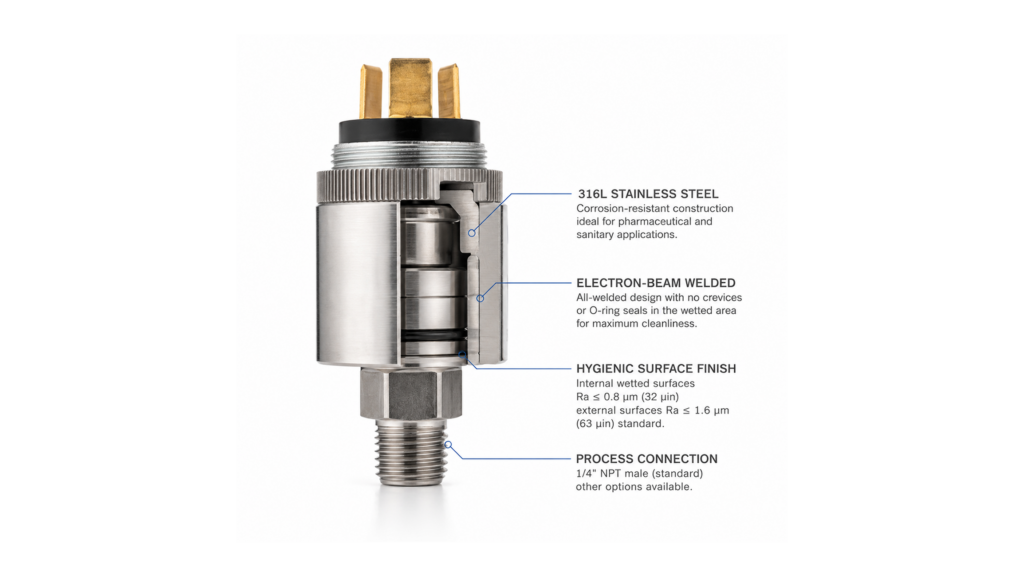
316L stainless steel is a low-carbon austenitic alloy. The “L” designation meaning low carbon is critical: it minimizes carbide precipitation during welding, which preserves corrosion resistance at weld seams. In pharmaceutical environments where sensors are welded into process lines, this distinction matters enormously.
What Makes 316L the Right Choice
- Superior Corrosion Resistance The inclusion of molybdenum (2–3%) gives 316L markedly better resistance to chlorides, organic acids, and aggressive cleaning agents compared to standard 304-grade steel. In facilities running CIP (clean-in-place) or SIP (steam-in-place) cycles, this is essential.
- Chemically Inert Wetted Surface 316L does not react with pharmaceutical process media. It will not alter the color, flavor, pH, or chemical composition of a product, a baseline requirement for any sensor in direct product contact.
- Precision Manufacturing for Leak-Tight Integrity Whitman’s Ultra Pure W117 series is constructed from 316L stainless steel that is electron-beam welded and helium leak-tested to a leakage rate of 4×10⁻⁹ Std CC/sec, a specification that meets the leak integrity demands of medical and pharmaceutical-grade systems.
- Thermal Durability Through Sterilization Cycles These sensors withstand continuous operating temperatures up to 105°C, making them compatible with steam sterilization and high-temperature washdown protocols without dimensional change or surface degradation.
USP Class VI Polymers: The Biocompatibility Benchmark
Not all sensor components can be made from metal. Diaphragms, seals, cable jackets, and housing elements often require polymers or elastomers and in pharmaceutical applications, not just any polymer will do.
USP Class VI is a classification under the United States Pharmacopeia that subjects materials to a battery of in-vivo biological tests. Passing this classification means a material has demonstrated:
Key Properties of USP Class VI-Rated Materials
- Proven Biocompatibility Class VI testing evaluates systemic toxicity, intracutaneous reactivity, and implantation response. A material that passes is confirmed non-toxic and safe for contact with pharmaceutical-grade fluids and medical-grade environments.
- Controlled Extractables and Leachables USP Class VI materials are engineered to release negligible levels of chemical substances into contact media. This is critical for preventing migration of plasticizers, stabilizers, or processing residues into sensitive drug formulations.
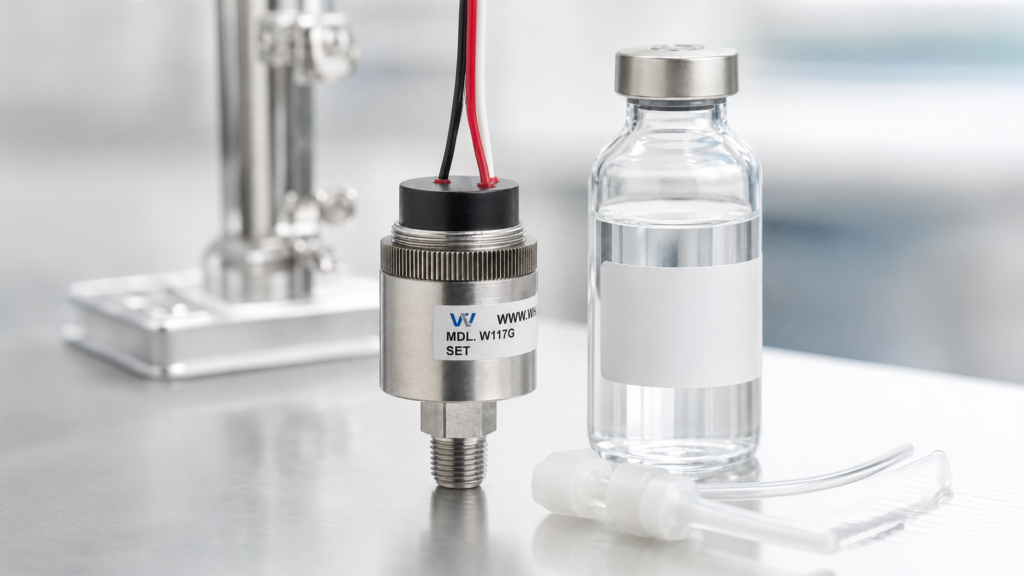
- Hygienic Design Compatibility Class VI materials are frequently paired with NSF-rated cable and cord assemblies to ensure that even the external cabling of a sensor system introduces no contaminants into potable water or sterile fluid systems.
Standardizing on High-Purity Materials: The OEM Advantage
For pharmaceutical packaging OEMs and medical device manufacturers, material standardization across a sensor portfolio is not just a procurement convenience, it is a validation and compliance strategy.
Why Standardization Reduces Risk
- Validation-Ready by Design Sensors built from 316L and USP Class VI materials arrive with documented material certifications. This accelerates IQ/OQ/PQ (Installation, Operational, and Performance Qualification) cycles and reduces the burden of justifying material choices to regulatory bodies.
- Simplified Spare Parts Management Customers who have standardized on Whitman’s high-purity sensor platforms have reduced their spare parts inventory requirements by up to 16%, a direct operational cost saving that compounds over time.
- Fewer Variants, Higher Confidence Reducing a parts list from dozens of loosely specified SKUs to a small set of validated, standardized models means 100% consistent performance across the production line and fewer field service calls.
Recommended Models for Pharmaceutical Applications
- W117LG Pressure Switch – helium-leak checked, washdown-rated, 316L wetted parts
- W117LV Vacuum Switch – same construction standard, optimized for vacuum process monitoring
Both models are designed for direct integration into pharmaceutical and medical device manufacturing lines with no material substitution or modification required.
About Whitman Controls and Industrial Control Solutions
Whitman Controls, part of Industrial Control Solutions, has been manufacturing precision vacuum, temperature, pressure, and liquid level switches and sensors for over 40 years. What began as a focused instrumentation manufacturer has grown into a trusted name across some of the most demanding industries in the world – aerospace, defense, semiconductor, medical and industrial automation.
As a Service-Disabled Veteran-Owned Small Business, Industrial Control Solutions was built on the same principles that define military service: tireless dedication, rigorous quality standards, and an unwavering commitment to the mission. That foundation isn’t marketing language, it shapes how we engineer every product, handle every order, and support every client relationship.
We don’t offer off-the-shelf compromises. Every sensor solution we build is configurable to your exact application, accounting for media environment, pressure range, temperature exposure, mounting constraints, and dozens of other specifications. If a standard product doesn’t meet your requirements, we build one that does and we back it with full documentation and traceability at every step.
Every product ships with full traceability documentation under our ISO 9001:2015 certification, giving customers confidence that internal processes, materials, and finished products have all met the highest standards of quality and regulatory compliance.
At Industrial Control Solutions, our most loyal clients have been with us for the entirety of our 40+ years in business. That kind of partnership isn’t accidental. It is the direct result of a commitment to delivering exactly what we promise; high-quality products, built to specification, backed by people who stand behind their work.
Our product portfolio spans four specialized USA-manufactured lines:
Whitman Controls – Vacuum, pressure, temperature, and liquid level switches engineered for precision and durability in extreme environments
Load Controls – Pump load controls, compact power sensors, fast-response load controllers, current sensors, and VFD-compatible solutions
Thomas Products – Flow switches, level switches, pump controls, multi-level switches, and visual indicators
Duro-sense – High-quality platinum and noble thermocouples, RTDs, and ISO 17025 calibrated wire
Frequently Asked Questions
Q: What is USP Class VI and why does it matter for pharmaceutical sensors?
USP Class VI is a United States Pharmacopeia material classification that certifies a polymer or elastomer as biocompatible through a defined series of biological tests. For pharmaceutical sensors, it confirms that wetted polymer components will not leach toxic substances or cause biological reactions when in contact with drug formulations or medical-grade fluids.
Q: Why is 316L stainless steel preferred over standard 316 in pharma applications?
The “L” in 316L stands for low carbon. Lower carbon content reduces carbide precipitation at weld zones, which is where standard 316 most commonly loses corrosion resistance. In pharmaceutical sensors that are welded into process lines or exposed to cleaning agents, 316L maintains a fully corrosion-resistant surface throughout the assembly, including at welds.
Q: What does “validation-ready” mean in the context of pharmaceutical instrumentation?
A validation-ready sensor is one that arrives with documented material certifications, traceability, and a construction standard that supports regulatory qualification protocols (IQ/OQ/PQ). Using materials like 316L and USP Class VI polymers with documented compliance reduces the time and cost of getting instrumentation approved for use in an FDA-regulated manufacturing environment.
Q: Can Whitman Controls build sensors to custom specifications for pharmaceutical applications?
Yes. Industrial Control Solutions builds and ships sensor solutions to exact customer specifications. Customers can specify process media, environmental conditions, connection types, and dozens of other parameters. Custom configurations are available across the pressure, vacuum, temperature, and level sensing product lines.