
What Is Pressure Monitoring in HVAC Systems and Why Does It Matter?
In modern building management, HVAC (Heating, Ventilation, and Air Conditioning) systems are often the largest consumers of energy. Precise pressure monitoring is a fundamental strategy for optimizing these systems, moving from static operation to demand-based performance. By using high-accuracy pressure switches and transmitters, facility managers can significantly reduce electrical loads, extend equipment life, and maintain superior indoor air quality.
How Does Demand-Controlled Ventilation Use Pressure Monitoring to Optimize Fan Speed?
Traditional HVAC systems often run fans at a constant speed, regardless of the actual cooling or heating demand. Precise pressure monitoring allows for the implementation of Variable Frequency Drives (VFDs) to modulate fan speeds based on real-time needs.
- Static Pressure Control Pressure sensors monitor the static pressure within supply ducts. As VAV (Variable Air Volume) boxes close, the pressure rises; sensors detect this and signal the VFD to slow the fan, saving significant energy.
- Filter Monitoring Differential pressure switches monitor the pressure drop across a filter. This ensures fans are not working overtime against a clean filter, while alerting staff exactly when a dirty filter is increasing resistance and wasting power.
- Reduced Over-Ventilation Precise sensors allow the system to provide only the necessary amount of fresh air, reducing the energy required to heat or cool excessive outdoor air.
How Do Pressure Switches Optimize the Refrigeration Cycle in HVAC Equipment?
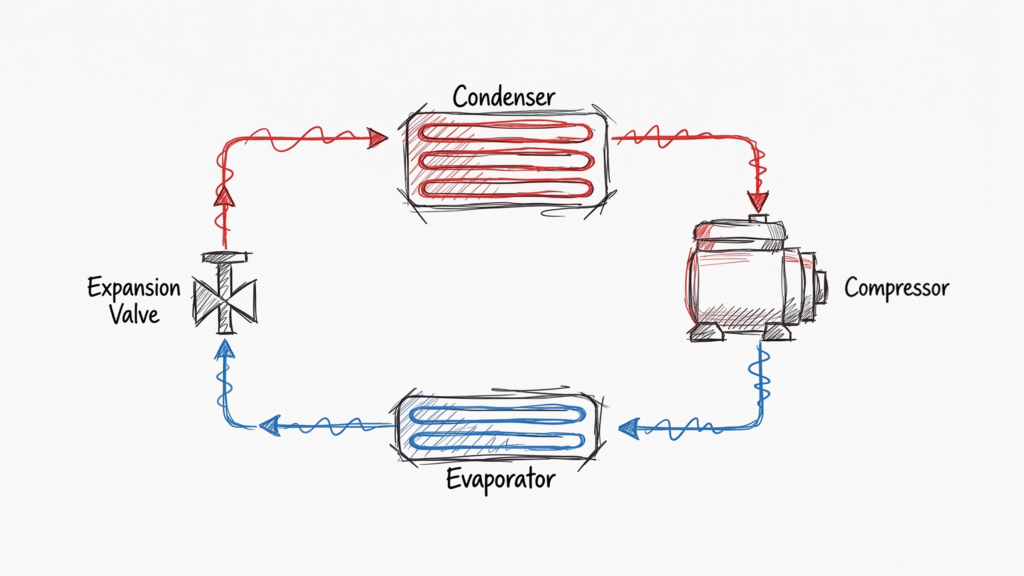
In the cooling side of an HVAC system, the refrigeration cycle must be carefully balanced. Pressure switches act as both safety devices and efficiency controllers for compressors and condensers.
- Optimized Head Pressure Pressure switches cycle condenser fans on and off based on refrigerant pressure, ensuring the system rejects heat efficiently without running fans unnecessarily in cooler ambient conditions.
- Preventing Short-Cycling High-accuracy switches like the Whitman P117 series prevent compressors from frequent on/off cycles known as short-cycling, which is highly energy-intensive and damaging to motors.
- Low-Charge Detection A drop in suction pressure can indicate a refrigerant leak. Early detection via pressure monitoring prevents the system from running in an inefficient low-charge state that consumes more power to reach temperature setpoints.
How Does Pressure Monitoring Enable Hydronic System Balancing and Pump Efficiency?
In systems that use chilled or heated water known as hydronic systems, pressure monitoring is essential for pump optimization and system balancing.
- Differential Pressure Across Pumps Monitoring the pressure difference between the suction and discharge sides of a pump allows the system to adjust pump speed to match the actual flow requirements of the building.
- Identifying Blockages Sudden pressure changes alert maintenance teams to fouled heat exchangers or closed valves that cause pumps to work against unnecessary resistance.
- Energy Savings According to the Affinity Laws for pumps and fans, reducing speed by just 20% can result in nearly a 50% reduction in power consumption.
About Whitman Controls and Industrial Control Solutions
Whitman Controls, part of Industrial Control Solutions, has been manufacturing precision vacuum, temperature, pressure, and liquid level switches and sensors for over 40 years. What began as a focused instrumentation manufacturer has grown into a trusted name across some of the most demanding industries in the world – aerospace, defense, semiconductor, medical and industrial automation.
As a Service-Disabled Veteran-Owned Small Business, Industrial Control Solutions was built on the same principles that define military service: tireless dedication, rigorous quality standards, and an unwavering commitment to the mission. That foundation isn’t marketing language, it shapes how we engineer every product, handle every order, and support every client relationship.
We don’t offer off-the-shelf compromises. Every sensor solution we build is configurable to your exact application, accounting for media environment, pressure range, temperature exposure, mounting constraints, and dozens of other specifications. If a standard product doesn’t meet your requirements, we build one that does and we back it with full documentation and traceability at every step.
Every product ships with full traceability documentation under our ISO 9001:2015 certification, giving customers confidence that internal processes, materials, and finished products have all met the highest standards of quality and regulatory compliance.
At Industrial Control Solutions, our most loyal clients have been with us for the entirety of our 40+ years in business. That kind of partnership isn’t accidental. It is the direct result of a commitment to delivering exactly what we promise; high-quality products, built to specification, backed by people who stand behind their work.
Our product portfolio spans four specialized USA-manufactured lines:
Whitman Controls – Vacuum, pressure, temperature, and liquid level switches engineered for precision and durability in extreme environments
Load Controls – Pump load controls, compact power sensors, fast-response load controllers, current sensors, and VFD-compatible solutions
Thomas Products – Flow switches, level switches, pump controls, multi-level switches, and visual indicators
Duro-sense – High-quality platinum and noble thermocouples, RTDs, and ISO 17025 calibrated wire
Frequently Asked Questions
Q1. What does a pressure switch do in an HVAC system?
A pressure switch in an HVAC system monitors air or refrigerant pressure and triggers automated responses when pressure rises or falls beyond set thresholds. In duct applications, it signals Variable Frequency Drives to adjust fan speed based on real-time demand. In refrigeration circuits, it protects compressors by preventing operation under unsafe high- or low-pressure conditions. This dual role efficiency controller and safety device, makes pressure switches one of the most critical components in modern HVAC design.
Q2. How does a differential pressure switch know when an HVAC filter needs replacing?
A differential pressure switch is installed with one port on the upstream (dirty) side of the filter and one on the downstream (clean) side. When the filter is clean, air passes through with minimal resistance and the pressure difference between both sides remains low. As particulate accumulates, upstream pressure climbs while downstream pressure holds, widening the differential. Once this gap reaches the switch’s set threshold, it triggers an alert to the building automation system, signaling that the filter needs replacement. This replaces fixed-schedule changes with condition-based maintenance, saving both energy and cost.
Q3. How much energy can HVAC systems save with pressure-based Variable Frequency Drive (VFD) control?
According to the Affinity Laws for pumps and fans, reducing motor speed by just 20% cuts power consumption by approximately 50%. Pressure sensors enable this by continuously feeding real-time duct or system pressure data to the VFD, which modulates motor speed to match actual building demand rather than running at fixed capacity. The U.S Department of Energy estimates that 70–90% of commercial HVAC systems have at least one energy-wasting fault, many of which pressure monitoring can detect and correct automatically.
Q4. What is HVAC short-cycling and how do pressure switches prevent it?
Short-cycling occurs when an HVAC compressor turns on and off in rapid, repeated cycles typically because of pressure imbalances in the refrigerant circuit. Each start draws a large electrical current surge, accelerating motor wear and consuming significantly more energy than sustained operation. High-accuracy pressure switches prevent short-cycling by holding the compressor off until system pressure returns to a safe operating range, ensuring the unit completes full, efficient cycles rather than hammering the motor with repeated restarts.
Q5. What pressure sensor accuracy is required for HVAC energy efficiency applications?
For HVAC systems where energy optimization is the goal, pressure sensors need to maintain accuracy within ±0.25% to ±1.0% of full scale depending on the application. Duct static pressure control and filter monitoring typically use differential pressure sensors with ranges of 0.1 to 5 inches of water column, fine enough to detect small changes in airflow resistance. Refrigeration high-side tracking uses gauge pressure sensors in the 0-500 PSI range, while low-side monitoring typically requires 0-150 PSI. Sensors operating outside these accuracy bands will produce control errors that accumulate into measurable energy waste over time.