

Managing chemical inventory demands a high degree of precision. The aggressive, volatile, and often expensive nature of these substances leaves little room for error. A continuous level transmitter allows facilities to move beyond simple high/low alarms and gain real-time data essential for safety, regulatory compliance, and operational efficiency. At Whitman Controls, we design high-accuracy sensing technology built for long-term stability in even the most demanding media environments.
Turning Real-Time Data into Actionable Insights
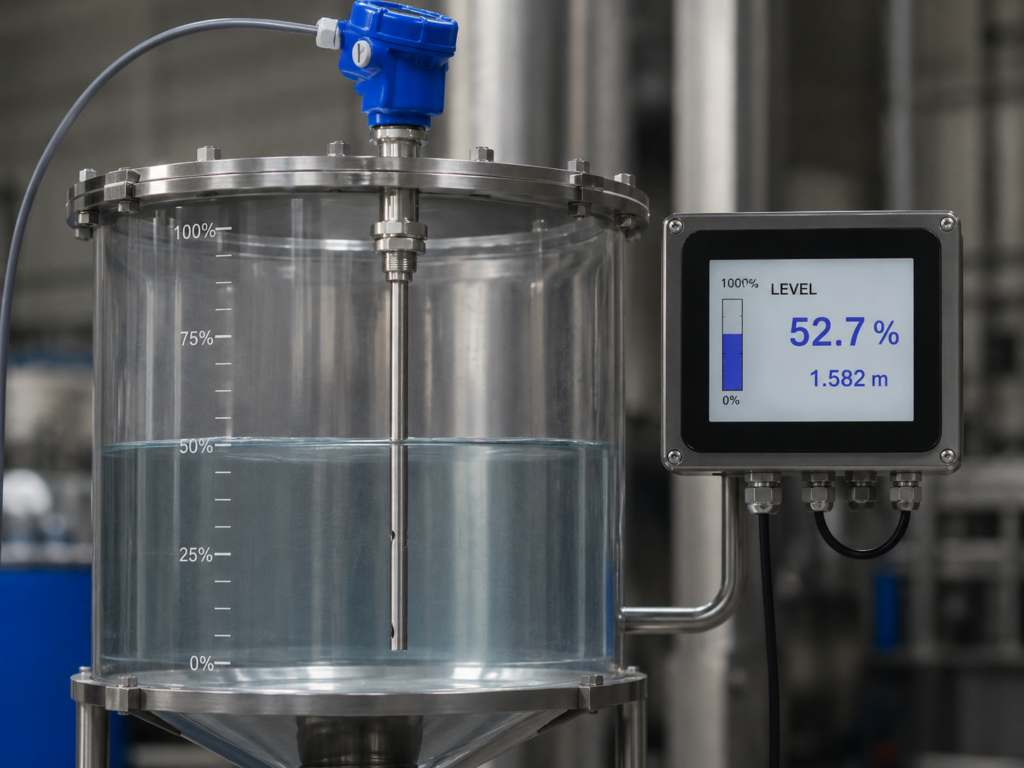
A continuous level transmitter converts the physical height of a chemical volume into an analog electrical output, typically 4–20mA or 0–10V. This signal connects to downstream displays, PLCs, or advanced control systems, allowing operators to monitor inventory without physically gauging the tank.
- Engineering Unit Conversion: Programming a level controller with the vessel’s true diameter or dimensions allows the transmitter’s raw reading to be converted into standard engineering units such as gallons or pounds.
- Predictive Replenishment: Continuous data enables usage trending over time, allowing facilities to automate replenishment schedules and adjust running levels based on actual demand rather than manual checks.
- Leak and Upset Detection: Automated systems can analyze level trends to identify gradual volume drifts that may indicate a slow leak or an upstream process upset before they become critical failures.
- Precision Control: In high-tech fabrication environments such as semiconductor manufacturing, transmitters ensure precise contact time and chemical ratios both vital for maintaining consistent product quality.
Selecting the Right Sensing Technology for Chemicals
Not all chemicals interact the same way with standard sensing materials. Choosing the correct instrument style and wetted materials is the most critical step in building a reliable, long-lasting inventory system.
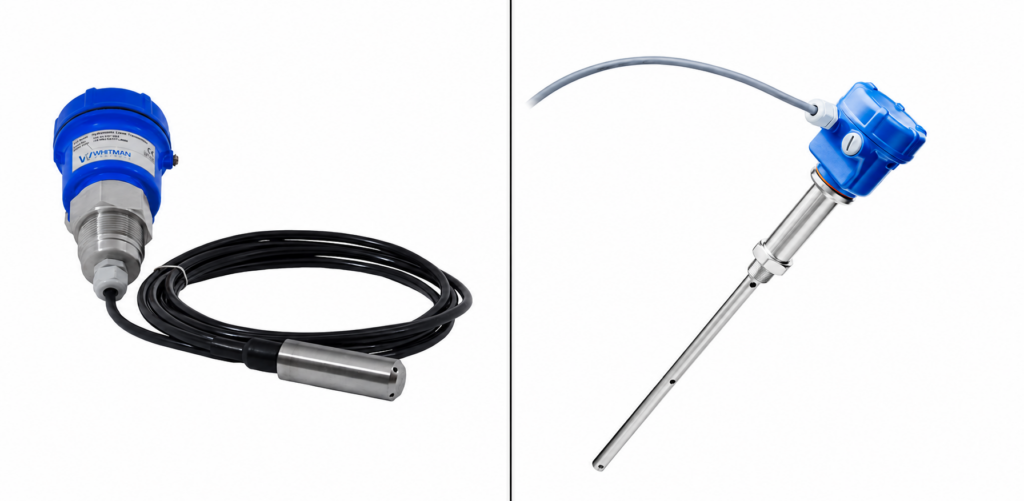
- Hydrostatic Measurement: Best suited for clean liquids with consistent temperatures, hydrostatic transmitters like the Whitman L95 series calculate tank level by measuring the pressure exerted by the fluid column above the sensor.
- Capacitance Sensing: For hazardous or pressurized materials, the Whitman L96 series is typically preferred. It measures level by detecting changes in dielectric constants between the liquid and gas phases, and is often installed in an external standpipe to isolate the sensor from vapor boil-off fluctuations.
- Material Compatibility: In aggressive chemical environments, instruments should be specified with compatible sensing diaphragms such as ceramic or 316 stainless steel along with appropriate cord materials for submersible configurations.
- Ultra-Pure Requirements: Processes that require contaminant-free environments benefit from fully welded, helium leak-tested housings, which provide absolute protection against impurities entering the process stream.
Strategic Installation for Industrial Reliability
The physical environment of a chemical storage tank, whether a large outdoor reservoir or a compact above-ground process vessel, determines the most appropriate installation method.
- Compact Style: These units integrate into a single housing and mount on the exterior bottom sidewall of a vessel. They are well suited for above-ground tanks where maintaining a clear interior is a requirement.
- Submersible Style: For large or below-ground vessels, the sensor element is lowered directly into the liquid via a long cordset. This style is valued for its straightforward installation, the sensor simply drops in from above.
- Reference Pressure: Depending on tank design, users must select the appropriate pressure reference: atmospheric (open tanks), absolute (vacuum or sealed systems), or differential (pressurized tanks).
- Safety Redundancy: In critical applications, a continuous transmitter is typically paired with discrete point-level switches to provide a secondary safety alarm or emergency shutoff if the primary monitoring system fails.
About Whitman Controls and Industrial Control Solutions
Whitman Controls, part of Industrial Control Solutions, has been manufacturing precision vacuum, temperature, pressure, and liquid level switches and sensors for over 40 years. What began as a focused instrumentation manufacturer has grown into a trusted name across some of the most demanding industries in the world – aerospace, defense, semiconductor, medical and industrial automation.
As a Service-Disabled Veteran-Owned Small Business, Industrial Control Solutions was built on the same principles that define military service: tireless dedication, rigorous quality standards, and an unwavering commitment to the mission. That foundation isn’t marketing language, it shapes how we engineer every product, handle every order, and support every client relationship.
We don’t offer off-the-shelf compromises. Every sensor solution we build is configurable to your exact application, accounting for media environment, pressure range, temperature exposure, mounting constraints, and dozens of other specifications. If a standard product doesn’t meet your requirements, we build one that does and we back it with full documentation and traceability at every step.
Every product ships with full traceability documentation under our ISO 9001:2015 certification, giving customers confidence that internal processes, materials, and finished products have all met the highest standards of quality and regulatory compliance.
At Industrial Control Solutions, our most loyal clients have been with us for the entirety of our 40+ years in business. That kind of partnership isn’t accidental. It is the direct result of a commitment to delivering exactly what we promise; high-quality products, built to specification, backed by people who stand behind their work.
Our product portfolio spans four specialized USA-manufactured lines:
Whitman Controls – Vacuum, pressure, temperature, and liquid level switches engineered for precision and durability in extreme environments
Load Controls – Pump load controls, compact power sensors, fast-response load controllers, current sensors, and VFD-compatible solutions
Thomas Products – Flow switches, level switches, pump controls, multi-level switches, and visual indicators
Duro-sense – High-quality platinum and noble thermocouples, RTDs, and ISO 17025 calibrated wire
Frequently Asked Questions
Q. What is a continuous level transmitter used for?
A continuous level transmitter measures real-time liquid height in a tank and converts it into an electrical signal typically 4–20mA or 0–10V, which connects to PLCs or control systems for automated inventory monitoring and process control.
Q. How do I choose between hydrostatic and capacitance level sensors for chemicals?
Hydrostatic sensors, like the Whitman L95, are best for clean, stable-temperature liquids. Capacitance sensors, like the Whitman L96, are preferred for hazardous, pressurized, or vapor-heavy chemical environments where isolating the sensor from the process is important.
Q. What materials are compatible with aggressive chemical media?
Sensors specified with ceramic or 316 stainless steel diaphragms handle most aggressive chemicals. For ultra-pure process requirements, fully welded, helium leak-tested housings prevent any risk of contamination.
Q. When should a transmitter be paired with a point-level switch?
Any critical application where a single-point failure could result in a safety hazard or significant process upset should include a discrete point-level switch as a backup alarm or emergency shutoff alongside the primary continuous transmitter.