
Data centers generate enormous amounts of heat. Without efficient, continuously monitored refrigeration, servers can throttle, fail, or cause cascading outages. Systems like Computer Room Air Conditioning (CRAC) and Chilled Water Systems are the backbone of thermal management but they only perform reliably when paired with the right sensors.
Monitoring these refrigeration cycles requires a strategic combination of pressure sensors, temperature sensors, and liquid level transmitters that feed real-time data to a Building Management System (BMS) or Programmable Logic Controller (PLC). At Whitman Controls, we manufacture the high-accuracy instrumentation data center operators depend on to manage wide heat load swings and maintain 24/7 uptime.
1. Continuous Level Transmitters for Coolant Reservoirs
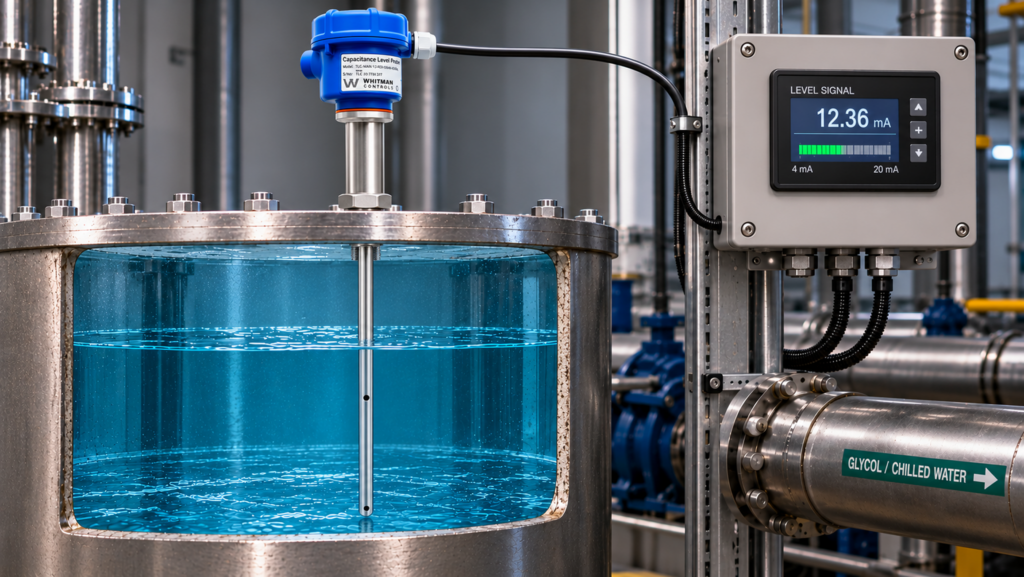
In chilled water or glycol-based systems, knowing the exact volume of coolant at all times is critical not just for inventory, but for leak detection and pump protection. A simple float switch can tell you a tank is “low,” but that’s already too late. A continuous level transmitter provides a constant, actionable data stream.
Key Benefits of Continuous Level Transmitters in Data Centers:
- Real-Time Coolant Inventory: Transmitters like the Whitman L96 Capacitance Series output a 4–20mA or 0–10V signal, enabling precise, continuous tracking of coolant levels across your BMS dashboard. No manual readings, no guesswork.
- Early Leak Detection: By monitoring level trends over time rather than just threshold crossings, your BMS can identify minute volume drifts, the early signature of a slow leak before they escalate into a system-wide “slugging” event that can damage pumps and compressors.
- Variable Frequency Drive (VFD) Integration: Continuous level data allows pump speeds to be modulated based on actual coolant demand. This reduces energy consumption significantly compared to fixed-speed operation, a meaningful advantage in facilities running around the clock.
- Material Compatibility for Immersion Cooling: For facilities using dielectric fluid in immersion cooling setups, 316L stainless steel sensor bodies ensure zero contamination risk. The sensor materials are matched to the fluid, not just the pressure range.
2. Pressure Switches for Compressor and Pump Protection
Refrigeration cycles depend on precise pressure differentials across compressors and evaporators. A deviation in either direction – head pressure too high, suction pressure too low, signals a fault that can destroy a compressor within minutes. Pressure switches are your primary automated line of defense.
How Pressure Switches Protect Data Center Cooling Systems:
- High/Low Pressure Cut-Outs (Safety Interlocks): The Whitman P117 Series pressure switches are deployed as hard safety interlocks. If head pressure spikes beyond the safe operating threshold, or suction pressure drops, indicating a blockage or refrigerant loss the switch immediately cuts power to the compressor, preventing mechanical failure.
- Pump Flow Verification: Pressure switches can verify that a pump is actually moving fluid by sensing the differential pressure across the pump head. This protects against “dry-run” scenarios where a pump runs without circulation, generating heat rather than removing it.
- Automated Condenser Fan Control: By wiring pressure switches into condenser fan circuits, facilities can automate fan cycling based on live refrigerant pressure readings. Fans run only when needed, optimizing heat rejection while eliminating unnecessary energy draw.
- Built for High-Cycle Mechanical Rooms: Data center mechanical rooms are vibration-rich, high-cycle environments. Whitman’s pressure switches are engineered to maintain calibrated set points even after thousands of operations, a non-negotiable for 24/7 critical infrastructure.
3. Temperature-Level Combination Sensors for Compact Cooling Modules
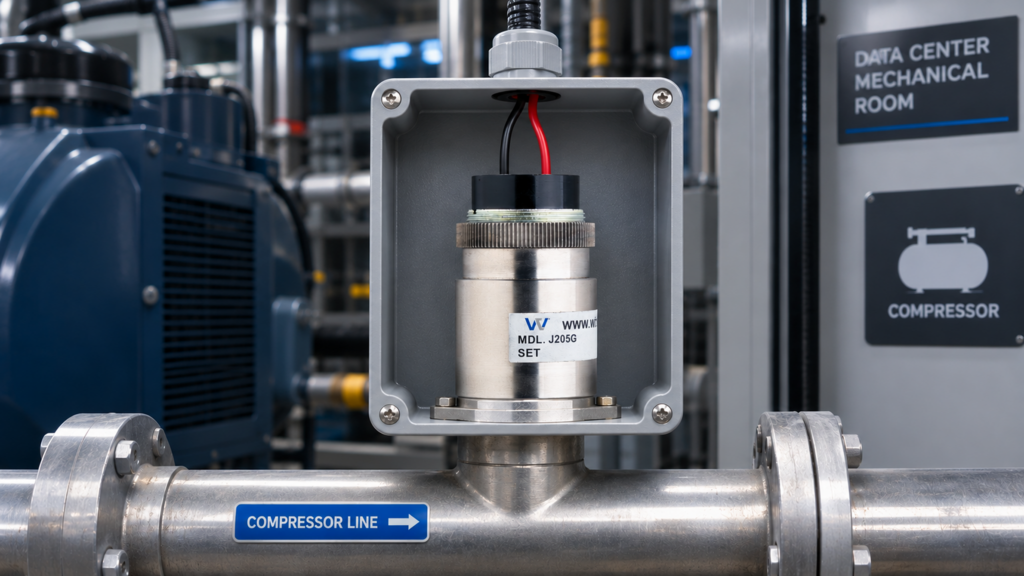
As data center hardware grows denser and cooling modules shrink, the number of process connections in any given cooling loop becomes a liability, each fitting is a potential leak point. Combination sensors address this directly.
Why Data Center OEMs Are Adopting Combination Sensors:
- Dual-Function Monitoring Through a Single Process Connection: These sensors simultaneously monitor coolant level and return-line temperature through one fitting. Fewer connections mean fewer failure modes, a critical consideration in tightly packaged cooling hardware.
- Rapid Thermal Outlier Detection: High-density server racks can produce sudden, localized temperature spikes that outpace slower monitoring systems. Combination sensors provide the fast-response data needed to trigger immediate cooling ramp-ups before thermal thresholds are breached.
- Space Efficiency for Denser Deployments: By consolidating two sensor functions into one unit, engineers recover physical space within the cooling hardware footprint, space that can be reallocated to additional server rack capacity, which is ultimately what the facility is there to deliver.
4. Strategic Sourcing and Sensor Reliability for Critical Infrastructure
In data center operations, uptime is the only metric that matters. Every sensor decision is also a supply chain decision, a quality decision, and ultimately a risk management decision.
- ISO 9001:2015 Certified Manufacturing: Every Whitman Controls sensor shipped for a data center application has passed through ISO 9001:2015 certified internal processes. This isn’t a marketing claim, it’s a documented quality system with audit trails.
- Domestic Sourcing with Predictable Lead Times: Headquartered in Bristol, CT, Whitman Controls offers 2–4 week lead times on standard and custom configurations. Facility upgrades and emergency replacements aren’t held hostage to overseas freight schedules.
- Custom Calibration to Match Your Cooling Media: Coolant properties vary, glycol concentration, specific gravity, and operating temperature all affect sensor accuracy. Whitman provides custom set points and specific gravity calibrations to match the exact properties of your fluid, ensuring measurement accuracy from day one.
About Whitman Controls and Industrial Control Solutions
Whitman Controls, part of Industrial Control Solutions, has been manufacturing precision vacuum, temperature, pressure, and liquid level switches and sensors for over 40 years. What began as a focused instrumentation manufacturer has grown into a trusted name across some of the most demanding industries in the world – aerospace, defense, semiconductor, medical and industrial automation.
As a Service-Disabled Veteran-Owned Small Business, Industrial Control Solutions was built on the same principles that define military service: tireless dedication, rigorous quality standards, and an unwavering commitment to the mission. That foundation isn’t marketing language, it shapes how we engineer every product, handle every order, and support every client relationship.
We don’t offer off-the-shelf compromises. Every sensor solution we build is configurable to your exact application, accounting for media environment, pressure range, temperature exposure, mounting constraints, and dozens of other specifications. If a standard product doesn’t meet your requirements, we build one that does and we back it with full documentation and traceability at every step.
Every product ships with full traceability documentation under our ISO 9001:2015 certification, giving customers confidence that internal processes, materials, and finished products have all met the highest standards of quality and regulatory compliance.
At Industrial Control Solutions, our most loyal clients have been with us for the entirety of our 40+ years in business. That kind of partnership isn’t accidental. It is the direct result of a commitment to delivering exactly what we promise; high-quality products, built to specification, backed by people who stand behind their work.
Our product portfolio spans four specialized USA-manufactured lines:
Whitman Controls – Vacuum, pressure, temperature, and liquid level switches engineered for precision and durability in extreme environments
Load Controls – Pump load controls, compact power sensors, fast-response load controllers, current sensors, and VFD-compatible solutions
Thomas Products – Flow switches, level switches, pump controls, multi-level switches, and visual indicators
Duro-sense – High-quality platinum and noble thermocouples, RTDs, and ISO 17025 calibrated wire
Frequently Asked Questions
Q: What is the difference between a pressure switch and a pressure transmitter for cooling system monitoring?
A: A pressure switch outputs a binary signal, it trips at a set point to open or close a circuit. A pressure transmitter outputs a continuous analog signal (typically 4–20mA) proportional to the actual pressure value. Switches are ideal for safety cut-outs and alarms; transmitters are better suited for trend monitoring and proportional control in a BMS.
Q: Why use a continuous level transmitter instead of a float switch in a coolant reservoir?
A: Float switches only alert you when a level crosses a fixed threshold by which point a significant volume may already be lost. Continuous transmitters provide a live data stream, enabling early drift detection (slow leaks), VFD pump modulation, and accurate inventory tracking, all of which are critical in facilities where even minor coolant loss can trigger cascading failures.
Q: What refrigerant pressure ranges do data center pressure switches typically need to cover?
A: This depends on the refrigerant used (R-410A, R-134a, R-32, etc.) and the system design, but most commercial CRAC and chiller applications require high-pressure cut-outs between 400–600 psi and low-pressure cut-outs between 20–60 psi. Whitman Controls can configure switches to custom set points for your specific refrigerant and operating conditions.
Q: Are combination temperature-level sensors compatible with dielectric fluids used in immersion cooling?
A: Yes, provided the sensor wetted materials are specified correctly. For dielectric immersion cooling fluids, 316L stainless steel or PTFE-wetted sensors are typically recommended to ensure chemical compatibility and zero contamination risk.
Q: How quickly can Whitman Controls supply replacement sensors for emergency repairs?
A: Standard configurations are typically available with 2–4 week lead times from our Bristol, CT facility. For time-critical situations, it’s recommended to discuss stocking agreements or pre-configured spares with our team to eliminate lead time risk entirely.