

UL and CE Certification: Two Standards, Two Markets
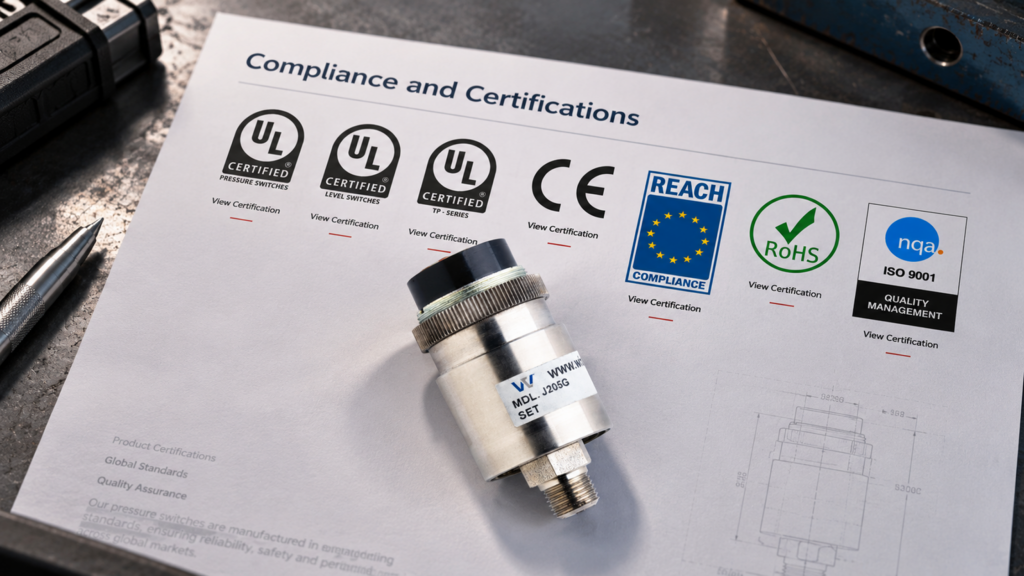
In the global marketplace, UL (Underwriters Laboratories) and CE (Conformité Européenne) certifications serve as essential safety and compliance benchmarks but they operate under entirely different legal frameworks and geographical scopes.
Understanding which certification applies and when is critical for OEMs and facility managers who need their equipment to be installation-ready and compliant with local electrical codes from day one.
UL Certification: The Compliance Standard for North America
UL certification is the primary requirement for pressure switches being installed in the United States and Canada. While not always mandated at the federal level, it becomes a practical requirement through local codes, inspection bodies, and insurance.
Key scenarios where UL certification is required:
- National Electrical Code (NEC) Compliance: Local electrical inspectors, formally called Authorities Having Jurisdiction (AHJs) will not approve a building’s electrical installation if components, including pressure switches, are not UL Listed or UL Recognized.
- Safety-Critical Interlocks: Applications such as boiler over-pressure controls, fire suppression systems, and medical gas distribution systems mandate UL certification due to the life-safety stakes involved.
- Industrial Insurance Requirements: Many industrial insurance policies explicitly require that all electrical control components meet UL safety standards to mitigate liability from fire or electrical shock incidents.
UL Recognized vs. UL Listed – What’s the Difference?
| Mark | Symbol | Scope |
| UL Recognized | $RU$ | Certified as a component within a larger UL-certified assembly or machine |
| UL Listed | $UL$ (circled) | Certified as a standalone product approved for direct field installation |
Choosing the wrong mark for your application especially in safety interlock systems can lead to failed inspections or voided warranties.
CE Marking: The Compliance Passport for the European Economic Area
The CE mark is a mandatory conformity marking for any product placed on the market within the European Economic Area (EEA). It functions as the manufacturer’s self-declaration that the product meets EU directives on safety, health, and environmental protection.
For pressure switches specifically, CE compliance is governed by three primary directives:
- Pressure Equipment Directive (PED): Governs the design and manufacture of equipment subject to pressure hazards. Any pressure switch operating above defined thresholds must meet PED requirements to carry the CE mark.
- Low Voltage Directive (LVD): Applies to pressure switches operating within 50–1000V AC or 75–1500V DC ranges, requiring demonstrated electrical safety compliance.
- Electromagnetic Compatibility (EMC) Directive: For electronic pressure transmitters such as the Whitman L95 series, CE marking also confirms the device will not generate electromagnetic interference and is protected against it from external sources.

When Both UL and CE Are Required: Dual Certification for Global OEMs
For Original Equipment Manufacturers with a global customer base, dual certification is not optional, it is the baseline.
When dual certification becomes essential:
- Global Export Compliance: A machine manufactured in the U.S. (requiring UL-compliant internal components) destined for Germany or France (requiring CE-marked equipment) must have pressure switches carrying both marks or face customs delays, import refusal, and legal liability.
- Simplified Bill of Materials (BOM): High-tier OEMs standardize on dual-certified components across all product builds. This eliminates the need for region-specific variants and ensures 100% order fulfillment success regardless of the end market.
Applications Where Certification Is Non-Negotiable
While a basic low-voltage air compressor switch may receive less regulatory scrutiny, the following applications almost always mandate certified instrumentation:
- Hazardous Locations: Pressure switches used near flammable gases such as hydrogen (H₂) or hydrogen sulfide (H₂S) require UL/cUL Class I, Division 1 certification in North America, or ATEX certification in Europe or both for global deployments.
- Medical Equipment: Oxygen concentrators and surgical vacuum systems require UL and CE certified switches to meet stringent healthcare safety protocols and regulatory approvals.
- Fire Protection Systems: Pressure switches monitoring fire sprinkler headers must carry UL and FM (Factory Mutual) approval to guarantee reliable operation during actual emergencies.
About Whitman Controls and Industrial Control Solutions
Whitman Controls, part of Industrial Control Solutions, has been manufacturing precision vacuum, temperature, pressure, and liquid level switches and sensors for over 40 years. What began as a focused instrumentation manufacturer has grown into a trusted name across some of the most demanding industries in the world – aerospace, defense, semiconductor, medical and industrial automation.
As a Service-Disabled Veteran-Owned Small Business, Industrial Control Solutions was built on the same principles that define military service: tireless dedication, rigorous quality standards, and an unwavering commitment to the mission. That foundation isn’t marketing language, it shapes how we engineer every product, handle every order, and support every client relationship.
We don’t offer off-the-shelf compromises. Every sensor solution we build is configurable to your exact application, accounting for media environment, pressure range, temperature exposure, mounting constraints, and dozens of other specifications. If a standard product doesn’t meet your requirements, we build one that does and we back it with full documentation and traceability at every step.
Every product ships with full traceability documentation under our ISO 9001:2015 certification, giving customers confidence that internal processes, materials, and finished products have all met the highest standards of quality and regulatory compliance.
At Industrial Control Solutions, our most loyal clients have been with us for the entirety of our 40+ years in business. That kind of partnership isn’t accidental. It is the direct result of a commitment to delivering exactly what we promise; high-quality products, built to specification, backed by people who stand behind their work.
Our product portfolio spans four specialized USA-manufactured lines:
Whitman Controls – Vacuum, pressure, temperature, and liquid level switches engineered for precision and durability in extreme environments
Load Controls – Pump load controls, compact power sensors, fast-response load controllers, current sensors, and VFD-compatible solutions
Thomas Products – Flow switches, level switches, pump controls, multi-level switches, and visual indicators
Duro-sense – High-quality platinum and noble thermocouples, RTDs, and ISO 17025 calibrated wire
Frequently Asked Questions
Q1: Is UL certification legally mandatory for pressure switches in the United States?
UL certification is not always a federal law, but it is a practical requirement in most installations. Local Authorities Having Jurisdiction (AHJs) enforcing the National Electrical Code (NEC) will typically refuse to approve electrical installations that use non-UL Listed or non-UL Recognized components. Insurance policies for industrial facilities also commonly mandate UL compliance.
Q2: What is the difference between UL Listed and UL Recognized for a pressure switch?
A UL Listed pressure switch (ULUL UL mark) is certified as a standalone product ready for direct field installation. A UL Recognized switch (RURU RU mark) is certified only as a component to be used inside a larger UL-certified machine or assembly. Selecting the wrong designation for your application can result in a failed electrical inspection.
Q3: What EU directives apply to pressure switches carrying the CE mark?
CE marking for pressure switches typically requires compliance with three directives: the Pressure Equipment Directive (PED), which governs pressure hazard safety; the Low Voltage Directive (LVD), which applies to switches within specific voltage ranges; and the EMC Directive, which ensures electronic pressure transmitters do not cause or suffer from electromagnetic interference.
Q4: Do OEMs always need both UL and CE certified pressure switches?
If an OEM manufactures equipment in North America and exports it to EU markets or vice versa then yes, dual certification is effectively mandatory. Using dual-certified components also simplifies the Bill of Materials (BOM) and eliminates the operational risk of fulfillment failures tied to destination-specific compliance gaps.
Q5: What certifications are required for pressure switches in hazardous locations?
In North America, pressure switches used near flammable or explosive gases must carry UL/cUL Class I, Division 1 certification. In Europe, the equivalent is ATEX certification. For global deployments in hazardous locations, both certifications should be present on the switch.