

In industrial automation, a “nuisance trip” the unintended actuation of a safety switch or sensor when no actual danger exists is far more than a minor inconvenience. It leads to lost production time, accelerated wear on mechanical components like motor starters, and “alarm fatigue,” a documented safety hazard where operators begin ignoring alerts and miss genuine emergencies.
Reducing nuisance trips requires a combination of precise hardware selection and intelligent signal management. Below are five engineering strategies that address the most common root causes.
1. Increase Hysteresis and Deadband Settings
One of the most common causes of nuisance trips is a set point that is too narrow. When a pressure or level switch has a minimal deadband, small, normal fluctuations in the system such as a pump starting up, can cause the switch to toggle repeatedly.
- Mechanical Adjustment: Selecting a switch with a wider differential ensures that once the switch trips, the system must move significantly back toward the normal operating range before it resets. This prevents the switch from cycling on minor variations.
- The Buffer Effect: Increasing the deadband also prevents contact chatter, a condition where electrical contacts bounce open and closed near the set point. Contact chatter can confuse a PLC’s logic and cause premature relay wear.
2. Use Signal Dampening and PLC Time Delays to Filter False Trips
In many processes, a momentary spike is a standard part of normal operation, not an indication of a fault. Signal management strategies allow your control system to distinguish between the two.
- Electronic Time Delays: Program your PLC to require a sustained signal from the sensor typically two to three seconds before triggering an alarm or initiating a shutdown. This approach filters out transient spikes caused by events like valve closures or material entering a tank.
- Mechanical Snubbers: For pressure switches, a snubber acts as a physical shock absorber. Installed in the sensing line, it restricts fluid flow to the sensor and smooths out rapid pressure pulses that would otherwise register as a false trip.
- Surge Suppressors and Trip Delay Settings: In electrical load monitoring applications, using load controls with adjustable trip delay settings accommodates the high inrush current typical of motor startups without triggering an overcurrent shutdown.

3. How to Prevent Vibration-Induced Nuisance Trips
Industrial facilities generate constant vibration from rotating machinery, reciprocating compressors, and fluid-hammer events. When a sensing element is mounted on or near a vibration source, the switch may actuate from mechanical shock rather than a true process change.
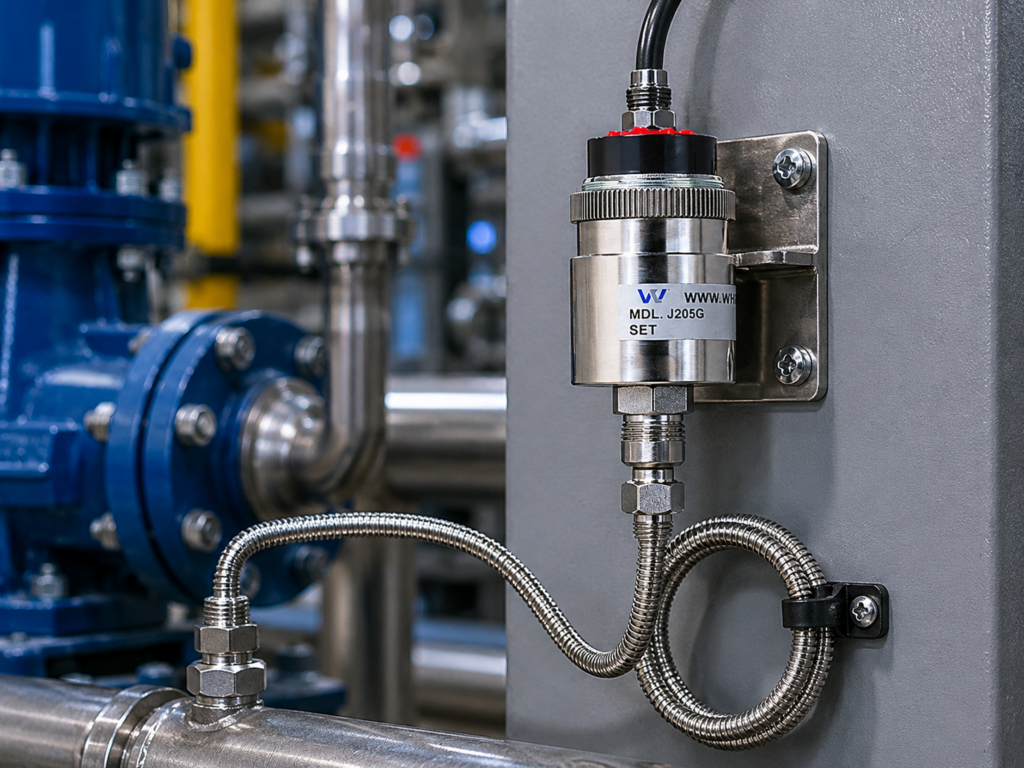
- Remote Mounting: If a pressure switch is nuisance-tripping due to vibration from the pump it is mounted on, relocate it to a stable, wall-mounted bracket and connect it to the process via a flexible capillary tube. This physically decouples the switch from the vibration source.
- Piston vs. Diaphragm Sensing Elements: Diaphragm switches are inherently more sensitive and more susceptible to vibration-induced trips. In high-vibration environments, a piston-actuated switch such as those in the Whitman P100 series, provides greater stability due to its higher moving mass and internal friction characteristics.
- Contact Quality: Ensure the switch uses high-quality internal return springs engineered to resist contact bounce during mechanical shock events.
4. Choose the Right Sensor Technology for Your Environment
Sometimes a nuisance trip is caused by the sensor responding to the wrong variable entirely- waves in a tank, radiated interference, or ambient temperature drift.
- Sloshing in Liquid Level Applications: A simple float switch can be actuated by wave action or sloshing in an agitated tank. Replacing it with a hydrostatic transmitter (such as the Whitman L95) or a multi-point level switch equipped with a slosh shield; a weighted, perforated tube that surrounds the float stabilizes the reading against surface turbulence.
- EMI and RFI Interference: Facilities with large motors and variable frequency drives (VFDs) generate significant electromagnetic interference (EMI) that can induce ghost signals on unshielded sensor wiring. Use shielded, twisted-pair cable and ensure the sensor housing and cable shield are properly grounded at a single point.
- Thermal Drift: If a sensor’s effective set point shifts as the facility warms up during a production shift, the unit may require temperature compensation. Alternatively, specifying sensors manufactured from materials with low thermal expansion coefficients such as 316L stainless steel can reduce drift in thermally dynamic environments.
5. Switch to Predictive Monitoring to Eliminate Nuisance Trips Long-Term
The most effective long-term strategy for eliminating nuisance trips is moving away from simple on/off switch logic toward continuous process data and analytics.
- Continuous 4–20mA Transmitters: Rather than receiving a binary trip signal, a PLC connected to a 4–20mA transmitter can monitor the full range of a process variable in real time. Sophisticated control logic such as a moving average or rate-of-change filter can then distinguish a genuine fault from a transient event that would have caused a nuisance trip under switch-based logic.
- Predictive Maintenance Integration: Logging trip frequency over time provides a leading indicator of sensor degradation. A sensor that begins tripping more frequently without a corresponding process change, is likely approaching end-of-life. Catching this pattern early prevents the sensor from becoming a chronic nuisance source.
About Whitman Controls and Industrial Control Solutions
Whitman Controls, part of Industrial Control Solutions, has been manufacturing precision vacuum, temperature, pressure, and liquid level switches and sensors for over 40 years. What began as a focused instrumentation manufacturer has grown into a trusted name across some of the most demanding industries in the world – aerospace, defense, semiconductor, medical and industrial automation.
As a Service-Disabled Veteran-Owned Small Business, Industrial Control Solutions was built on the same principles that define military service: tireless dedication, rigorous quality standards, and an unwavering commitment to the mission. That foundation isn’t marketing language, it shapes how we engineer every product, handle every order, and support every client relationship.
We don’t offer off-the-shelf compromises. Every sensor solution we build is configurable to your exact application, accounting for media environment, pressure range, temperature exposure, mounting constraints, and dozens of other specifications. If a standard product doesn’t meet your requirements, we build one that does and we back it with full documentation and traceability at every step.
Every product ships with full traceability documentation under our ISO 9001:2015 certification, giving customers confidence that internal processes, materials, and finished products have all met the highest standards of quality and regulatory compliance.
At Industrial Control Solutions, our most loyal clients have been with us for the entirety of our 40+ years in business. That kind of partnership isn’t accidental. It is the direct result of a commitment to delivering exactly what we promise; high-quality products, built to specification, backed by people who stand behind their work.
Our product portfolio spans four specialized USA-manufactured lines:
Whitman Controls – Vacuum, pressure, temperature, and liquid level switches engineered for precision and durability in extreme environments
Load Controls – Pump load controls, compact power sensors, fast-response load controllers, current sensors, and VFD-compatible solutions
Thomas Products – Flow switches, level switches, pump controls, multi-level switches, and visual indicators
Duro-sense – High-quality platinum and noble thermocouples, RTDs, and ISO 17025 calibrated wire
Frequently Asked Questions
Q. What is a nuisance trip in industrial automation?
A nuisance trip is the unintended actuation of a safety switch or sensor that occurs without an actual process fault caused by vibration, signal transients, tight deadband settings, or environmental interference. They reduce productivity and can create alarm fatigue.
Q. How does deadband (hysteresis) prevent nuisance trips?
A wider deadband means the process variable must travel further from the trip point before the switch resets. This prevents the switch from cycling on small, normal fluctuations near the set point.
Q. What is a pressure snubber and how does it help?
A pressure snubber is a fitting installed in the sensing line that restricts rapid fluid flow to the sensing element. It smooths pressure spikes and pulses, reducing the chance of a transient spike registering as a trip.
Q. When should I use a piston switch instead of a diaphragm switch?
In high-vibration environments, piston-actuated switches are the preferred choice. Their higher moving mass and internal friction make them far less sensitive to mechanical shock than diaphragm types.
Q. How do VFDs cause nuisance trips?
Variable frequency drives generate electromagnetic interference (EMI) that can induce false signals on sensor wiring. Shielded cables and proper single-point grounding are the primary countermeasures.